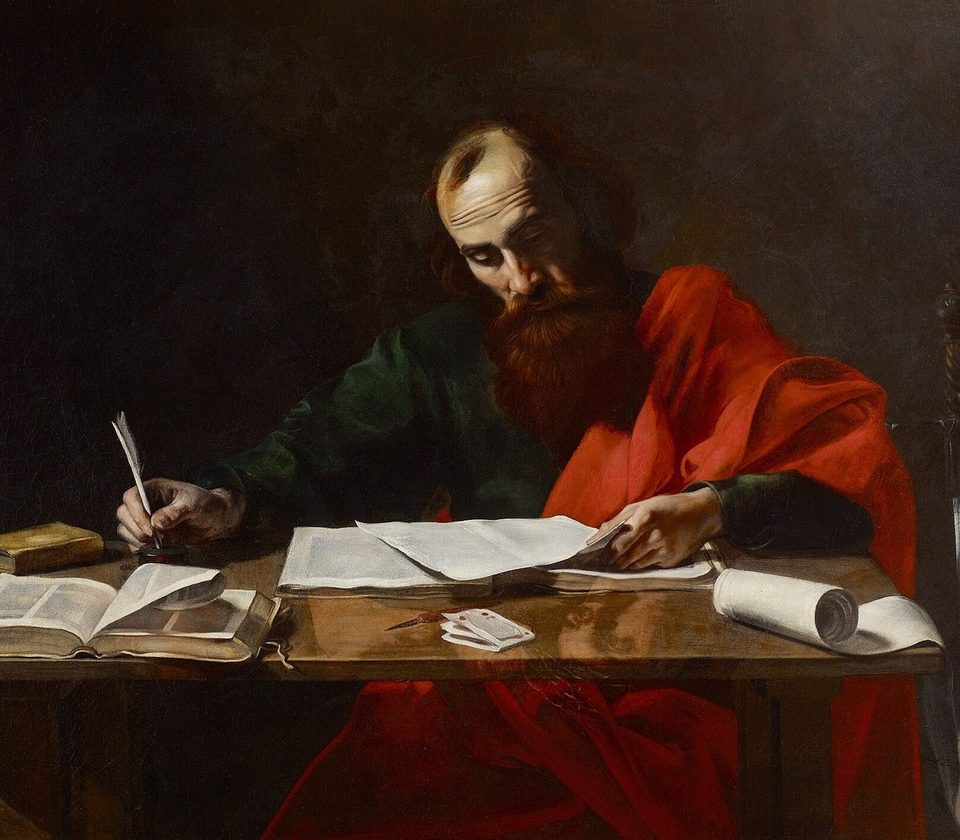

Rome, Paul in prison, his last letter
Paul is a prisoner, writing to his young friend Timothy.4 He knows the end is near: “the time of my dissolution is at hand.”5
In that one short letter, he says two things about how the faith is handed on. We will start with the one you know best.
01Your verse first
“All scripture, inspired of God”
“All scripture, inspired of God, is profitable to teach, to reprove, to correct, to instruct in justice: That the man of God may be perfect, furnished to every good work.”
“For leaving the commandment of God, you hold the tradition of men, the washing of pots and of cups: and many other things you do like to these.”
Read fairly, these say that Scripture is God-breathed and equips the believer, and that Jesus condemned human traditions that push aside God’s command. Catholics accept every word of both.
Now the other thing Paul tells Timothy, one chapter earlier.
02The Catholic reading
Written, and handed on
“And the things which thou hast heard of me by many witnesses, the same commend to faithful men who shall be fit to teach others also.”
“Therefore, brethren, stand fast: and hold the traditions, which you have learned, whether by word or by our epistle.”
The Catechism points out that the first generation of Christians did not yet have a written New Testament. It distinguishes apostolic Tradition, which hands on what the apostles received from Jesus, from the many local customs and “traditions” that grew up over time.10
So where exactly do we part ways?
03The real disagreement
Where we think it lies
Not over whether Scripture is inspired. The question is whether Scripture is the only infallible rule of faith, and who has the authority to interpret it when sincere Christians disagree.
The Church teaches that it “does not derive her certainty about all revealed truths from the holy Scriptures alone.”3 It holds that Tradition, Scripture and the Magisterium are so connected that one of them cannot stand without the others.12
Paul himself called the Church “the pillar and ground of the truth.”13
An honest question back, offered gently: how do we know which books belong in the Bible? Our page on the canon looks at that.
Paul wrote 3:16. He also wrote 2:2. Catholics try to keep both.
Careful with the facts
- The Church teaches that the Magisterium is not superior to the Word of God but is its servant.11
Christian to Christian
Your love for Scripture is something Catholics share and honour. The Church urges all the faithful to frequent reading of the Bible.
Only one thing to do
Your one next step
Read 2 Timothy 2 and 3 in one sitting, about ten minutes. Notice 2:2 and 3:16 together, and ask what Paul expected Timothy to do with each.
Read 2 Timothy 2Keep going
Notes
- Catechism of the Catholic Church, paragraph 105. vatican.va
- Catechism of the Catholic Church, paragraph 76. vatican.va
- Catechism of the Catholic Church, paragraph 82. vatican.va
- 2 Timothy 1:8, Douay-Rheims. read the chapter
- 2 Timothy 4:6, Douay-Rheims. read the chapter
- 2 Timothy 3:16-17, Douay-Rheims. read the chapter
- Mark 7:8, Douay-Rheims. read the chapter
- 2 Timothy 2:2, Douay-Rheims. read the chapter
- 2 Thessalonians 2:14, Douay-Rheims. read the chapter
- Catechism of the Catholic Church, paragraph 83. vatican.va
- Catechism of the Catholic Church, paragraph 86. vatican.va
- Catechism of the Catholic Church, paragraph 95. vatican.va
- 1 Timothy 3:15, Douay-Rheims. read the chapter
Translations of the Fathers and councils are public-domain 19th-century editions. Catechism links open vatican.va. Scripture: Douay-Rheims, Challoner revision. Stone & Incense restates Church teaching and history in plain words; our wording is not an official Church text. Report an error.