.jpg)
The Last Supper
At the Last Supper Jesus turns to one man: “Simon, Simon, behold Satan hath desired to have you, that he may sift you as wheat.”6
“But I have prayed for thee, that thy faith fail not: and thou, being once converted, confirm thy brethren.”7
A prayer for Peter, and a task: strengthen the others. Was that for Peter alone?
01Your verse first
“Other foundation no man can lay”
“For other foundation no man can lay, but that which is laid: which is Christ Jesus.”
Read fairly: Christ alone is the foundation of the Church. Many Protestants read the “rock” in Matthew 16 as Peter’s confession of faith, or as Christ himself, and see papal claims as growing up centuries later, around popes such as Leo the Great.
That reading has ancient support, and it is fair to say so.910 St John Chrysostom explained the rock as “on the faith of his confession.”9 St Augustine wrote: “On this rock, therefore, He said, which you have confessed, I will build my Church.” He went on: “For the Rock (Petra) was Christ.”10
The Catechism itself holds more than one reading together: on the rock of the faith Peter confessed, Christ built his Church, and the Lord made Simon, whom he named Peter, the rock of his Church.111
Catholics agree Christ is the foundation. The question is what he built on it.
02The Catholic reading
The rock and the keys
“And I say to thee: That thou art Peter; and upon this rock I will build my church, and the gates of hell shall not prevail against it. And I will give to thee the keys of the kingdom of heaven. And whatsoever thou shalt bind upon earth, it shall be bound also in heaven: and whatsoever thou shalt loose on earth, it shall be loosed also in heaven.”
Scripture also says the Church is built on the foundation of the apostles, with Christ as the chief cornerstone.13 The Catechism teaches that the Lord made Simon alone, whom he named Peter, the rock of his Church, and gave him the keys.1
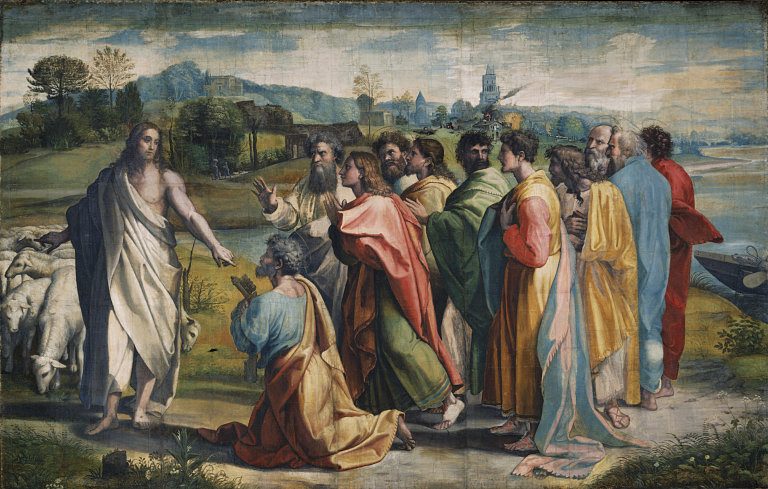
“He said to him the third time: Simon, son of John, lovest thou me? Peter was grieved because he had said to him the third time: Lovest thou me? And he said to him: Lord, thou knowest all things: thou knowest that I love thee. He said to him: Feed my sheep.”
Then the evidence question: did anyone act as if Rome had a special role, early on?
03Before Leo
The first two centuries
Around the year 96, when the church in Corinth was split, it was the Church of Rome that wrote to set things right, through St Clement.2
Around 180, Irenaeus listed the bishops of Rome back to the apostles, with Eleutherius “in the twelfth place from the apostles.”15 The Catechism quotes him: “For with this church, by reason of its pre-eminence, the whole Church, that is the faithful everywhere, must necessarily be in accord.”3
There were limits too, and they matter. When Pope Victor tried to cut off the churches of Asia over the date of Easter and declared them excommunicate, other bishops were not pleased. Eusebius records words of theirs “sharply rebuking Victor.” Irenaeus, he says, “fittingly admonishes Victor that he should not cut off whole churches of God.”4
So Rome’s voice carried weight, but it was not simply obeyed without question, and the forms of its authority developed over time.45
So what is left to disagree about?
04The real disagreement
Where we think it lies
Not whether Peter was prominent; the Gospels show that. The question is whether his role was a personal privilege or an office meant to continue.
The Church teaches that the office the Lord gave to Peter alone was “destined to be transmitted to his successors.”17
It is also honest that for many centuries East and West followed their own ways in a brotherly union, with the Roman See acting as guide by common consent when disagreements arose.5
“Confirm thy brethren.” Catholics believe that prayer did not end with Peter.
Careful with the facts
Christian to Christian
Catholics and Protestants agree that Christ is the one foundation and the head of the Church. That is not a small thing to share.
Only one thing to do
Your one next step
Read Luke 22:31-34 and John 21:15-19 side by side. Same man, before and after his failure, and a task given both times.
Read John 21Keep going
Notes
- Catechism of the Catholic Church, paragraph 881. vatican.va
- St. Clement of Rome, Letter to the Corinthians (c. 96). Ante-Nicene Fathers vol. 1 (1885), trans. Roberts and Donaldson. newadvent.org
- Catechism of the Catholic Church, paragraph 834. vatican.va
- Eusebius, Church History, Book V, ch. 24 (c. 324). Nicene and Post-Nicene Fathers, 2nd series, vol. 1 (1890), New Advent. newadvent.org
- Unitatis Redintegratio 14 (Vatican II, Decree on Ecumenism, 1964). vatican.va
- Luke 22:31, Douay-Rheims. read the chapter
- Luke 22:32, Douay-Rheims. read the chapter
- 1 Corinthians 3:11, Douay-Rheims. read the chapter
- St. John Chrysostom, Homily 54 on Matthew (c. 390). Nicene and Post-Nicene Fathers, 1st series, vol. 10 (1888), New Advent. newadvent.org
- St. Augustine, Tractate 124 on the Gospel of John (c. 420). Nicene and Post-Nicene Fathers, 1st series, vol. 7 (1888), New Advent. newadvent.org
- Catechism of the Catholic Church, paragraph 424. vatican.va
- Matthew 16:18-19, Douay-Rheims. read the chapter
- Ephesians 2:20, Douay-Rheims. read the chapter
- John 21:17, Douay-Rheims. read the chapter
- St. Irenaeus of Lyons, Against Heresies III.3 (c. 180). Ante-Nicene Fathers vol. 1 (1885). newadvent.org
- Catechism of the Catholic Church, paragraph 882. vatican.va
- Catechism of the Catholic Church, paragraph 862. vatican.va
Translations of the Fathers and councils are public-domain 19th-century editions. Catechism links open vatican.va. Scripture: Douay-Rheims, Challoner revision. Stone & Incense restates Church teaching and history in plain words; our wording is not an official Church text. Report an error.