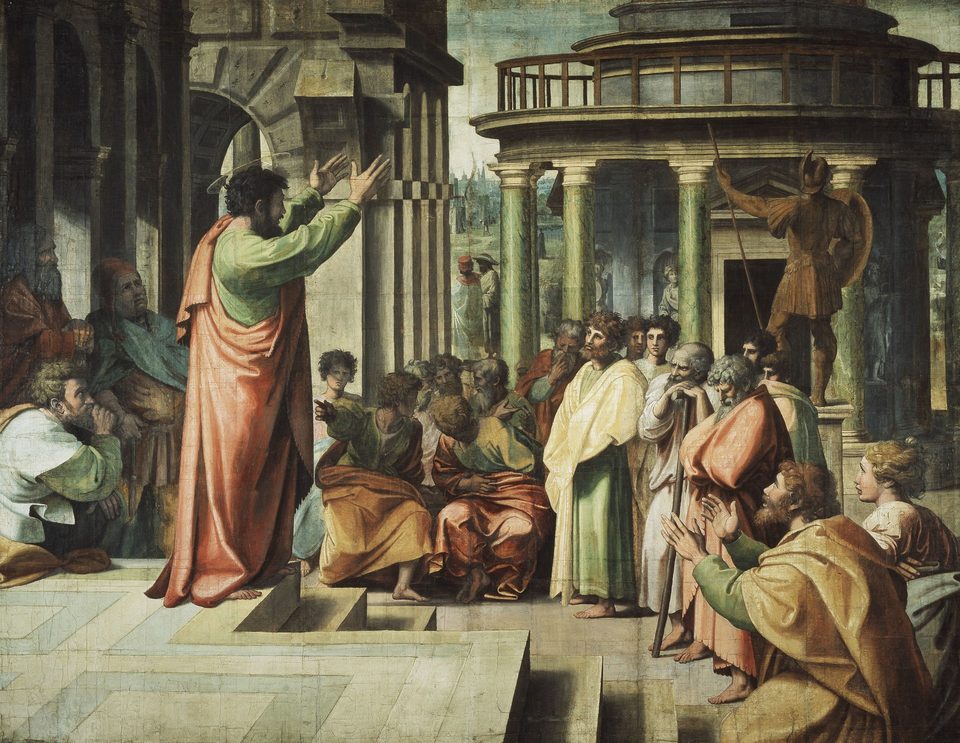

The Areopagus, Athens
Paul is walking through Athens and finds an altar with an inscription: “To the Unknown God.” Standing before the council, he says: “What therefore you worship without knowing it, that I preach to you.”6
God made the world, he tells them, so that people “should seek God, if haply they may feel after him or find him, although he be not far from every one of us.”78
The Athenians could accept a divine maker. What they could not get past was Paul’s claim that this God had acted.
01The objection
At full strength
Grant that a Creator is the best explanation of the universe. Why go further? A God who made the world need not speak, perform miracles, or found a church. Every religion adds claims, and they disagree. Why not stop at a maker and leave it there?
The Church agrees with the first step. In words taken from the First Vatican Council, it holds that God “can be known with certainty from the created world by the natural light of human reason.”1
The question is whether God stayed silent.
02Revelation
A God who speaks
There is another order of knowledge that we cannot reach by our own powers, the Catechism says: the order of divine Revelation. By a free decision, God has revealed himself and given himself to man.2
“God, who, at sundry times and in divers manners, spoke in times past to the fathers by the prophets, last of all, In these days, hath spoken to us by his Son, whom he hath appointed heir of all things, by whom also he made the world.”
We need that light even for truths reason could reach, so that they can be known by all “with firm certainty and with no admixture of error.”10
And unlike a private feeling, the central claim can be examined.
03The test case
What the evidence consists of
“And if Christ be not risen again, then is our preaching vain: and your faith is also vain.”
The Catechism calls the Resurrection “a real event, with manifestations that were historically verified.”3 It points to three kinds of evidence.345
You can weigh each of these for yourself. The Church does not ask you to skip the weighing.
The Church also points to signs such as miracles, prophecies, and the Church’s growth and holiness, which show that the assent of faith is “by no means a blind impulse of the mind.”14
Which leaves the other half of the objection: religions disagree.
04Many religions
If God spoke, why so many voices?
This is a fair point, not a dodge. Sincere people across the world hold sharply different beliefs about God, and it is reasonable to ask why that should not make us stop at a vague Creator.
The Church does not say the other religions are empty. The Second Vatican Council taught: “The Catholic Church rejects nothing that is true and holy in these religions.” Their teachings, it said, “often reflect a ray of that Truth which enlightens all men.”15
The Catechism sees in them a search, “among shadows and images,” for the God who is unknown yet near, and regards the goodness and truth found in them as a preparation for the Gospel.16
It does not conclude that all religions are equally true: in the same passage, the Council says the Church must proclaim Christ, “the way, the truth, and the life.”15 Nor does it condemn those who, through no fault of their own, do not know Christ: if they seek God with a sincere heart and, moved by grace, follow their conscience, they too may achieve eternal salvation.17
So disagreement is not treated as proof that no one has heard anything. The question becomes where the light is seen most fully, and that brings us back to a historical claim about one man and an empty tomb.
If God did act in Jesus, the next question is where that witness went.
05Why a Church
From a message to a people
The apostles left bishops as their successors so that the full and living Gospel would always be preserved in the Church.18
That is a historical claim, and The Case pages on how old the Church is and who carries the apostles’ authority set out the evidence for it.
Paul ended his speech with a man raised from the dead. Some mocked. Others said, “We will hear thee again concerning this matter.”
Careful with the facts
Christian to Christian
Believing in a Creator is real common ground. The step from there is not a leap in the dark; it is a question about what happened in history, and you are free to look into it at your own pace.
Only one thing to do
Your one next step
Read 1 Corinthians 15:1-11, the earliest written list of witnesses to the Resurrection. Ask one question of it: what would explain these people saying this?
Read 1 Corinthians 15Keep going
Notes
- Catechism of the Catholic Church, paragraph 36. vatican.va
- Catechism of the Catholic Church, paragraph 50. vatican.va
- Catechism of the Catholic Church, paragraph 639. vatican.va
- Catechism of the Catholic Church, paragraph 640. vatican.va
- Catechism of the Catholic Church, paragraph 643. vatican.va
- Acts 17:23, Douay-Rheims. read the chapter
- Acts 17:24, Douay-Rheims. read the chapter
- Acts 17:27, Douay-Rheims. read the chapter
- Hebrews 1:1-2, Douay-Rheims. read the chapter
- Catechism of the Catholic Church, paragraph 38. vatican.va
- 1 Corinthians 15:14, Douay-Rheims. read the chapter
- 1 Corinthians 15:5-8, Douay-Rheims. read the chapter
- Catechism of the Catholic Church, paragraph 644. vatican.va
- Catechism of the Catholic Church, paragraph 156. vatican.va
- Nostra Aetate 2 (Vatican II, Declaration on Non-Christian Religions, 1965). vatican.va
- Catechism of the Catholic Church, paragraph 843. vatican.va
- Catechism of the Catholic Church, paragraph 847. vatican.va
- Catechism of the Catholic Church, paragraph 77. vatican.va
Translations of the Fathers and councils are public-domain 19th-century editions. Catechism links open vatican.va. Scripture: Douay-Rheims, Challoner revision. Stone & Incense restates Church teaching and history in plain words; our wording is not an official Church text. Report an error.