
Journeys / Curious, or no faith / Step 5 of 9
Nicaea, AD 325
In the year 325, the first ecumenical council of the whole Church meets at Nicaea. A man named Arius has been teaching that the Son of God “came to be from things that were not.”4
In other words: Jesus is impressive, but created. Not truly God. Everything hangs on the answer. If Arius is right, Christians have been worshipping a creature. If he is wrong, the man from Nazareth is God himself.
01The verdict
“Begotten, not made”
The council’s answer went into its Creed: the Son is “begotten, not made, of the same substance (homoousios) as the Father.” The council condemned Arius’s teaching.4
“God of God, Light of Light, very God of very God, begotten (gennethenta), not made, being of one substance (homoousion, consubstantialem) with the Father”
Every Sunday, in parishes across the world, Catholics stand and say words descended from that Creed. Those words were once fiercely argued over.
That longer creed, finished at a second council in 381, is still shared by all the great Churches of East and West.6
But why call it a “Creed” at all? And why did the first Christians call it a “symbol”? The answer is a broken token.
02The word
A token that fits the other half
In Greek, symbolon meant half of a broken object, such as a seal given as a token. The two parts were fitted together to prove who the bearer was.1
ImagineA stranger arrives at your door claiming to be sent by a friend. You take out your half of a broken token. He takes out his. They fit.
That is what a creed is: “a sign of recognition and communion between believers.” It is also a summary of the main truths of the faith.1
And the oldest summary of all is older than any council. It is in the Bible.
03The evidence
Handed on from the start
From the beginning, the Church passed on her faith in short formulas. Very early she gathered the essentials into summaries, especially for people preparing for Baptism.10
You can see one in a letter St Paul wrote to Corinth. He is handing on what he himself was given.
“For I delivered unto you first of all, which I also received: how that Christ died for our sins, according to the scriptures: And that he was buried: and that he rose again the third day, according to the scriptures:”
These summaries were “not made to accord with human opinions”: they gather what matters most from all the Scriptures.10
So what is actually in it? Open any creed and you find the same shape: three parts.
04The shape
Three parts, one God
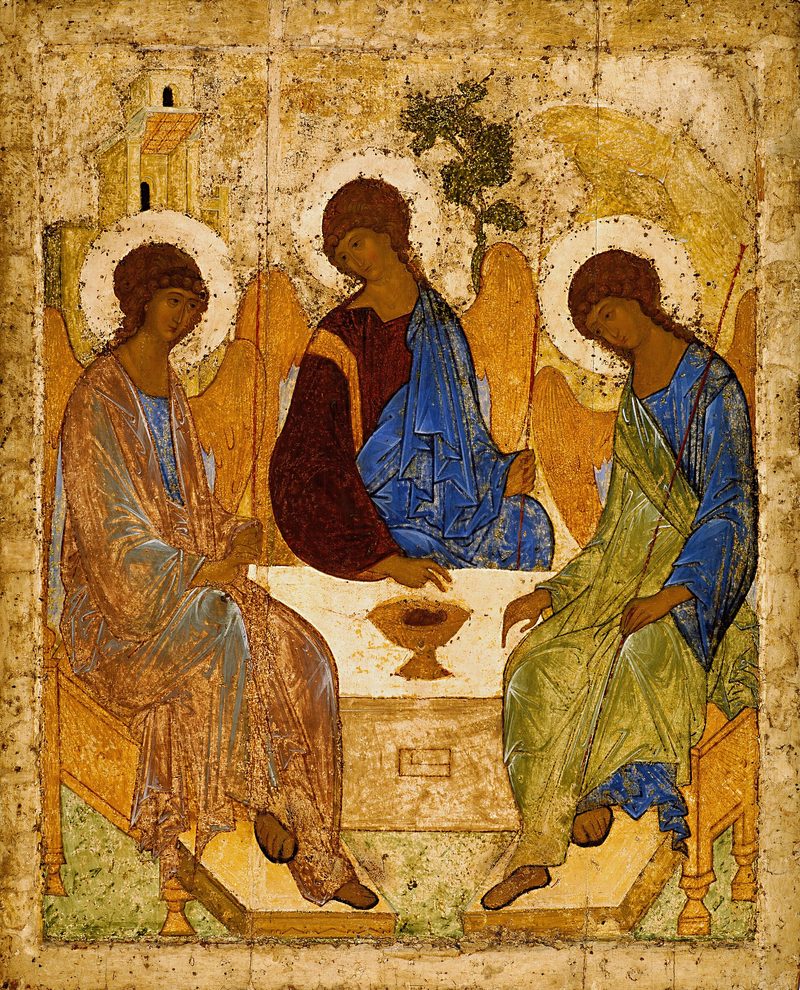
The first time anyone professes the faith is at Baptism, given “in the name of the Father and of the Son and of the Holy Spirit.”2 So every creed has three parts: the Father and creation, the Son and our redemption, the Holy Spirit who makes us holy.3
Notice it says “the name”, not “the names”, because there is only one God.12
The Apostles’ Creed
I believe in God, the Father Almighty, Creator of heaven and earth; and in Jesus Christ, His only Son, our Lord; who was conceived by the Holy Ghost, born of the Virgin Mary, suffered under Pontius Pilate, was crucified: died, and was buried. He descended into hell: the third day He arose again from the dead: He ascended into heaven, sitteth at the right hand of God, the Father Almighty; from thence He shall come to judge the living and the dead. I believe in the Holy Ghost, the Holy Catholic Church, the communion of Saints, the forgiveness of sins, the resurrection of the body, and the life everlasting. Amen.
Traditional English form, as printed in the Baltimore Catechism (1885, with imprimatur; public domain). Your parish may pray a newer translation approved for your country.
This short creed is called the Apostles’ Creed because it is a faithful summary of their faith; it is the ancient baptismal creed of the Church of Rome.13
Reading it is one thing. Saying it out loud is something else.
05The ending
Saying it is joining in
To say the Creed with faith is to enter into communion with God, Father, Son and Holy Spirit, and with the whole Church that hands it on.14 Whoever says “I believe” says “I pledge myself to what we believe.”15
Your half of the token, fitting into theirs. Across seventeen centuries.
Some lines will come easily. Some will catch in your throat. Both are a good place to start.
Your move
Try this, this week
- Read the Apostles’ Creed aloud. Mark the line you most want explained.
- Read 1 Corinthians 15:3-8. Paul hands on what he himself received.
- Listen for the Creed at a Sunday Mass. It comes after the homily, the short sermon.
- Ask a Catholic which line means most to them.
You’ll need
- The Apostles’ Creed, on paper or on your phone.
- Five minutes to read it aloud, slowly.
Remember Three parts, one God: Father, Son and Holy Spirit.
Optional: watch a short film
Video: The Creeds, Catholic Central. Link checked 4 October 2026. Loads from YouTube (privacy-enhanced mode) only when you press play. Watch on YouTube
What this video covers (summarized from the publisher’s description, not a transcript): Catholic Central looks at the history and importance of the Nicene and Apostles’ Creeds: where these words come from and why Catholics pray them.
What the Church teaches on this: The Apostles’ Creed is the ancient baptismal symbol of the Church of Rome, and the Nicene Creed stems from the first two ecumenical Councils. CCC 194 CCC 195
Videos come from faithful Catholic teachers. Where a video and this page differ in wording, the Catechism and Scripture cited here are the authority.
If this is hard
If some lines of the Creed are hard to say honestly right now, you are not alone. Many people begin with only a few lines they can say with confidence. Bring the hard lines to a priest or a Catholic friend; questions are welcome.
Two questions people ask
Why are there two creeds?
The Apostles’ Creed is a faithful summary of the apostles’ faith and the ancient baptismal symbol of the Church of Rome.13 The Nicene Creed stems from the first two ecumenical Councils, in 325 and 381, and remains common to all the great Churches of both East and West.6
Do I have to believe all of it?
Whoever says “I believe” says “I pledge myself to what we believe.” Communion in faith needs a common language of faith, normative for all and uniting all in the same confession of faith.15
Only one thing to do
Your one next step
Read the Apostles’ Creed above out loud, once, slowly. Put a mark by the one line you would most like explained. That line is your next question.
Back to the CreedStep 5 of 9 · Curious, or no faith
Believing is one thing. Talking to God is another. What is prayer, and how do you try it?
Step 6: PrayerTake it with you
Printable one-page cardDownload card (A4 PDF)Download card (US Letter PDF)Short link: stoneandincense-preview.pages.dev/go/cu5
Notes
- Catechism of the Catholic Church, paragraph 188. vatican.va
- Catechism of the Catholic Church, paragraph 189. vatican.va
- Catechism of the Catholic Church, paragraph 190. vatican.va
- Catechism of the Catholic Church, paragraph 465. vatican.va
- First Council of Nicaea (325), the Creed. Nicene and Post-Nicene Fathers, 2nd series, vol. 14 (1900). ccel.org
- Catechism of the Catholic Church, paragraph 195. vatican.va
- Catechism of the Catholic Church, paragraph 187. vatican.va
- Catechism of the Catholic Church, paragraph 884. vatican.va
- Catechism of the Catholic Church, paragraph 234. vatican.va
- Catechism of the Catholic Church, paragraph 186. vatican.va
- 1 Corinthians 15:3-4, Douay-Rheims. read the chapter
- Catechism of the Catholic Church, paragraph 233. vatican.va
- Catechism of the Catholic Church, paragraph 194. vatican.va
- Catechism of the Catholic Church, paragraph 197. vatican.va
- Catechism of the Catholic Church, paragraph 185. vatican.va
- Matthew 28:19, Douay-Rheims. read the chapter
Excerpts from the English translation of the Catechism of the Catholic Church for use in the United States of America Copyright © 1994, United States Catholic Conference, Inc. – Libreria Editrice Vaticana. Used with Permission. English translation of the Catechism of the Catholic Church: Modifications from the Editio Typica copyright © 1997, United States Conference of Catholic Bishops – Libreria Editrice Vaticana. Scripture: Douay-Rheims, Challoner revision (public domain). Early Christian writers: Ante-Nicene Fathers (1885, public domain). Video: “The Creeds,” Catholic Central, supporting material, not a teaching source.
Scenes marked “Imagine” are an invitation to picture the moment, not a historical record. Stone & Incense restates Church teaching in plain words; our wording is not an official Church text. Report an error.