
Journeys / Becoming Catholic / Step 5 of 6
Capharnaum, before dawn
It has been a long day in Capharnaum, a town by the Sea of Galilee.34 After sunset, “all the city was gathered together at the door,” and Jesus healed many who were sick.5
Very early the next morning, he goes out alone to a deserted place, “and there he prayed.”6
His friends go looking for him. When they find him, they have one line: “All seek for thee.” Everyone wants him. And he has chosen to spend the first hour of the day with his Father.
01The answer
What prayer actually is
The Catechism’s classic definition is short: “Prayer is the raising of one’s mind and heart to God or the requesting of good things from God.”1
That is it. Your mind. Your heart. Turned toward God. You can do that on a bus.
And here is the surprise: you are not the one who starts it. “It is he who first seeks us,” and prayer is “the encounter of God’s thirst with ours.”7
For a Christian, prayer is a living relationship with God the Father, with his Son Jesus Christ and with the Holy Spirit.2
Which sounds lovely, until you sit down and have no idea what to say. If that is you, you are in good company.
02The request
“Lord, teach us to pray”
One day, after watching Jesus pray, one of his disciples asked him: “Lord, teach us to pray.”8
These were men who walked with him every day and watched him pray. They still felt they did not know how.
The Church says that is exactly the right place to begin. Only when we humbly admit that we do not know how to pray as we ought are we ready to receive prayer as a gift.1 St Paul says the Spirit “helpeth our infirmity.”9
Jesus answered the request with a prayer of his own, which the Church calls the fundamental Christian prayer.10
“Thus therefore shall you pray: Our Father who art in heaven, hallowed be thy name. Thy kingdom come. Thy will be done on earth as it is in heaven. Give us this day our supersubstantial bread. And forgive us our debts, as we also forgive our debtors. And lead us not into temptation. But deliver us from evil. Amen.”
The first Christian communities prayed it three times a day.15
Words are one way in. The Church knows two others.
03The three ways
Words, thinking, and simply being there
Christian tradition keeps three main ways of praying, and they share one thing: a heart that is paying attention.16
<b>Vocal prayer</b> uses words, said aloud or silently, and what matters most is that your heart is present to the One you are speaking to.17
<b>Meditation</b> is a search: you think about a Gospel passage, for example, to understand what the Lord is asking of you.18
<b>Contemplation</b> is the simplest of all, in St Teresa’s words “a close sharing between friends.”19
Then you actually try it. And within about ten seconds, your mind is somewhere else.
04The honest part
When your mind wanders
The Catechism does not pretend this is easy. Prayer “always presupposes effort,” and it even calls prayer a battle.20
“The habitual difficulty in prayer is distraction.” The advice is gentle: do not go hunting distractions down; simply turn back to your heart.21
So your mind drifts to the shopping list. Notice it. Smile. Come back. No scolding required.
Which leaves the most practical question of all. When?
05The ending
An ordinary Tuesday
The Church says we cannot pray at all times if we never pray at specific times.22 So it suggests simple rhythms: morning and evening prayer, and grace before and after meals.13
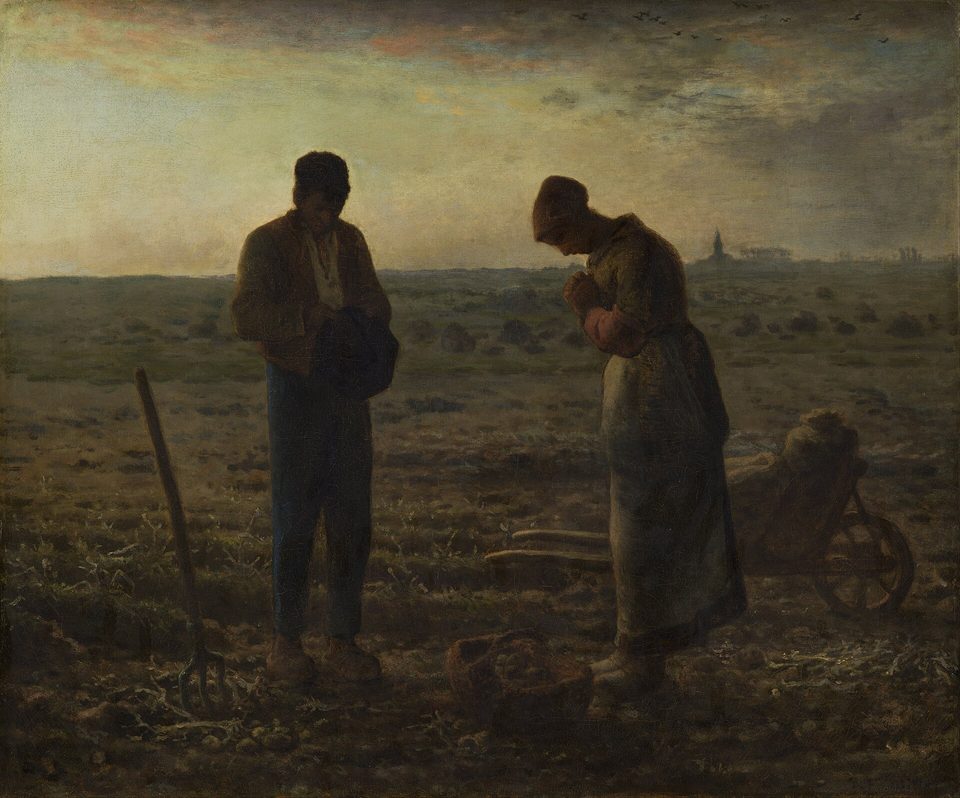
Look again at the painting at the top of this page: Millet’s The Angelus. Two farm workers have stopped in a field at dusk, heads bowed. No church. No special clothes. Just a pause in an ordinary working day.
Five minutes. Same time, same place, a few honest words. That is how it starts.
Your move
Try this, this week
- Pray the Our Father slowly, once. Stop on any line that catches you.
- Pick a time and a place. Five minutes at the same time each day is a good start.
- Read Mark 1:35 and Matthew 6:5-13. Notice where Jesus prays and how he tells us to pray.
- When your mind wanders, simply come back. Do not scold yourself; just begin again.
You’ll need
- Five quiet minutes, morning or evening.
- A Bible, open to Matthew 6 and Luke 11.
Remember Start small: same time, same place, a few honest words.
Optional: watch a short film
Video: Fr. Mike’s Prayer for Beginners, Ascension Presents (Ascension). Link checked 4 October 2026. Loads from YouTube (privacy-enhanced mode) only when you press play. Watch on YouTube
What this video covers (summarized from the publisher’s description, not a transcript): Fr. Mike Schmitz offers a simple pattern for prayer, T-A-R: tell the Lord what is on your heart, ask him for what you need, and rely on him to answer.
What the Church teaches on this: The Catechism names petition among the basic forms of prayer, and calls the battle of prayer one of humble, trusting and persevering love. CCC 2644 CCC 2742
Videos come from faithful Catholic teachers. Where a video and this page differ in wording, the Catechism and Scripture cited here are the authority.
If this is hard
If prayer feels dry, awkward or empty, you are in good company: many saints felt the same. Keep it short and keep showing up. If you are carrying something heavy, such as grief, guilt or anger at God, a priest will listen without judgment.
Two questions people ask
What if I do not know what to say?
The Catechism says we are ready to receive the gift of prayer only when we humbly acknowledge that we do not know how to pray as we ought.1 St. Paul writes that the Spirit helps our infirmity and “asketh for us with unspeakable groanings.”9
Why do my prayers seem unanswered?
The Catechism admits that some even stop praying because they think their petition is not heard. It asks two questions in return: why do we think our petition has not been heard, and how is our prayer heard, how is it “efficacious”?23
Do Catholics only pray set prayers?
The Lord leads each person by paths and in ways pleasing to him, and each believer responds with the personal expressions of his prayer.16 The Church also proposes rhythms of prayer, such as morning and evening prayer, grace before and after meals and the Liturgy of the Hours.13
Only one thing to do
Your one next step
Tonight, before you sleep, try our short evening prayer. Open it on your phone and follow along, one calm step at a time. It takes a few minutes.
Open Evening PrayerStep 5 of 6 · Becoming Catholic
You have met Jesus, his Church, the sacraments, the Mass and prayer. So how does a person actually become Catholic?
Step 6: The catechumenate (OCIA/RCIA)Take it with you
Printable one-page cardDownload card (A4 PDF)Download card (US Letter PDF)Short link: stoneandincense-preview.pages.dev/go/bc5
Notes
- Catechism of the Catholic Church, paragraph 2559. vatican.va
- Catechism of the Catholic Church, paragraph 2565. vatican.va
- Mark 1:21, Douay-Rheims. read the chapter
- Matthew 4:13, Douay-Rheims. read the chapter
- Mark 1:32-34, Douay-Rheims. read the chapter
- Mark 1:35, Douay-Rheims. read the chapter
- Catechism of the Catholic Church, paragraph 2560. vatican.va
- Luke 11:1, Douay-Rheims. read the chapter
- Romans 8:26, Douay-Rheims. read the chapter
- Catechism of the Catholic Church, paragraph 2759. vatican.va
- Matthew 6:9-13, Douay-Rheims. read the chapter
- Catechism of the Catholic Church, paragraph 2761. vatican.va
- Catechism of the Catholic Church, paragraph 2698. vatican.va
- Catechism of the Catholic Church, paragraph 1174. vatican.va
- Catechism of the Catholic Church, paragraph 2767. vatican.va
- Catechism of the Catholic Church, paragraph 2699. vatican.va
- Catechism of the Catholic Church, paragraph 2700. vatican.va
- Catechism of the Catholic Church, paragraph 2705. vatican.va
- Catechism of the Catholic Church, paragraph 2709. vatican.va
- Catechism of the Catholic Church, paragraph 2725. vatican.va
- Catechism of the Catholic Church, paragraph 2729. vatican.va
- Catechism of the Catholic Church, paragraph 2697. vatican.va
- Catechism of the Catholic Church, paragraph 2734. vatican.va
Excerpts from the English translation of the Catechism of the Catholic Church for use in the United States of America Copyright © 1994, United States Catholic Conference, Inc. – Libreria Editrice Vaticana. Used with Permission. English translation of the Catechism of the Catholic Church: Modifications from the Editio Typica copyright © 1997, United States Conference of Catholic Bishops – Libreria Editrice Vaticana. Scripture: Douay-Rheims, Challoner revision (public domain). Early Christian writers: Ante-Nicene Fathers (1885, public domain). Video: “Fr. Mike’s Prayer for Beginners,” Ascension Presents, supporting material, not a teaching source.
Scenes marked “Imagine” are an invitation to picture the moment, not a historical record. Stone & Incense restates Church teaching in plain words; our wording is not an official Church text. Report an error.