.jpg)
Journeys / Fallen-away Catholic / Step 3 of 7
A courtyard in Jerusalem, the night of the arrest
It is cold. Servants are standing around a fire of coals, warming their hands, and Peter is standing with them.3
A servant girl looks hard at him in the firelight: “This man also was with him.”4 Three times, Peter denies it.5
While he is still speaking, a rooster crows. And the Lord turns and looks at Peter.
01Before anything else
If you were harmed
Your safety comes first
If you or someone you love was abused by anyone in the Church, please contact the civil authorities and your diocese. Your diocese can tell you who to contact for reporting and for support.
You may also talk to any priest you trust, or to a counsellor, before you think about anything else on this page.
Some people drift away. Others were hurt: by a priest, by a parish, by family, or by the news. If that is you, your pain is real. You do not have to pretend otherwise here.
Back in the courtyard, Peter has just met the eyes of the friend he denied.
02The look
Peter failed too
“And the Lord turning looked on Peter. And Peter remembered the word of the Lord, as he had said: Before the cock crow, thou shalt deny me thrice. And Peter going out, wept bitterly.”
The Catechism describes that moment as “Jesus’ look of infinite mercy,” which drew tears of repentance from Peter.7
The man who would lead the Church started out by failing in the worst possible way, at the worst possible moment.
Which raises the hardest question of all. If people in the Church can fail that badly, how can anyone call it holy?
03The honest answer
A holy Church with sinners in it
The Church does not hide this. It teaches: “All members of the Church, including her ministers, must acknowledge that they are sinners.” It calls itself “at once holy and always in need of purification.”1
The Catechism is frank that priests are not preserved from “human weaknesses, the spirit of domination, error, even sin.” In many of their actions they leave human traces that are not always signs of fidelity to the Gospel.8
And it says what a priest should be: one who, like Christ, made himself “the least and the servant of all.”9
Even so, it is Christ who acts in the sacraments, so a priest’s unworthiness does not stop Christ from acting.2
Some people did not leave over a person. They left over a question nobody answered.
04The questions
“Will you also go away?”
Those questions deserve a real conversation, not a slogan. The Catechism is the place to read what the Church actually teaches, and a priest is the person to talk it through with. If your hurt involves a particular priest or parish, you are free to talk to a different one.
Once, after a hard teaching, many of Jesus’ followers “went back and walked no more with him.”10 He asked the Twelve if they wanted to leave too.11
“And Simon Peter answered him: Lord, to whom shall we go? Thou hast the words of eternal life.”
Peter said that before he failed. What happened after he failed is the end of the story.
05The ending
A second fire
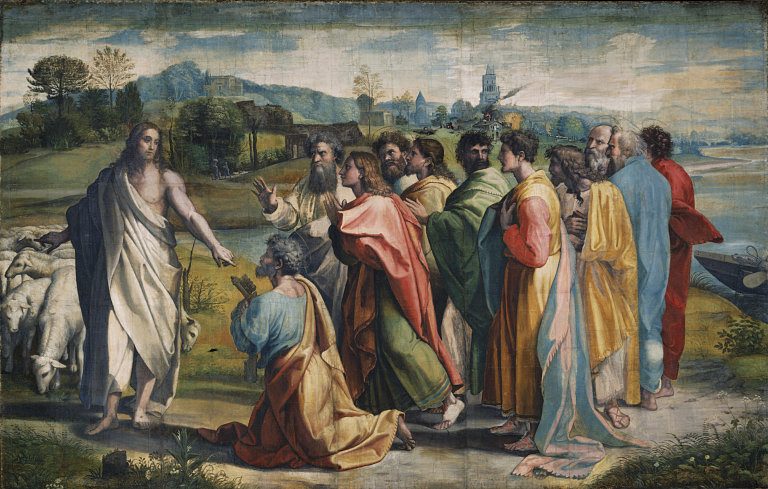
After the Resurrection, the disciples come ashore from a night of fishing and find “hot coals lying, and a fish laid thereon, and bread.”13 Jesus says: “Come and dine.”14
Another charcoal fire. He feeds Peter before he asks him anything.
“He said to him the third time: Simon, son of John, lovest thou me? Peter was grieved because he had said to him the third time: Lovest thou me? And he said to him: Lord, thou knowest all things: thou knowest that I love thee. He said to him: Feed my sheep.”
Three denials, then three questions.15 The Catechism calls Peter’s answer “a threefold affirmation of love.”7
Peter was not asked to pretend nothing had happened. He was asked one question. It is still being asked.
Your move
Try this, this week
- Read John 21:1-19. Notice that Jesus feeds Peter before he asks him anything.
- Write down the question or hurt that keeps you away. Be as honest as you like.
- Look up what the Church teaches about your question in the Catechism, not in headlines.
- Ask a priest for a conversation, not confession, if that feels easier.
You’ll need
- A Bible, open to John 21.
- Someone you trust to talk to.
Remember Your hurt is real, and so is Christ’s mercy.
Optional: watch a short film
Video: Why Remain Catholic? (With So Much Scandal), Bishop Robert Barron (Word on Fire). Link checked 4 October 2026. Loads from YouTube (privacy-enhanced mode) only when you press play. Watch on YouTube
What this video covers (summarized from the publisher’s description, not a transcript): Bishop Robert Barron says the outrage over the scandals is warranted, and asks Catholics not to flee but to fight with the weapons of the Spirit.
What the Church teaches on this: All members of the Church, including her ministers, must acknowledge that they are sinners. CCC 827
Videos come from faithful Catholic teachers. Where a video and this page differ in wording, the Catechism and Scripture cited here are the authority.
If this is hard
If you were harmed by someone in the Church, your safety and healing come first. Please contact the civil authorities and your diocese. You may talk to any priest you trust, or to a counsellor, before you think about anything else here.
Two questions people ask
How can the Church be holy when people in it did terrible things?
The Church is holy, though having sinners in her midst, because she herself has no other life but the life of grace. If her members move away from that life, they fall into sins and disorders that prevent the radiation of her sanctity.1
Are sacraments from a sinful priest still real?
The Church teaches that the unworthiness of the minister does not prevent Christ from acting.2 Even the minister’s sin cannot impede the fruit of grace in the sacraments.8
What should priests be like?
The Catechism says the exercise of priestly authority must be measured against the model of Christ, who by love made himself the least and the servant of all.9
Only one thing to do
Your one next step
Write down, in one sentence, the hurt or the question that keeps you away. Keep it. When you are ready, and only then, bring it to a priest you trust, as a conversation rather than a confession.
How to talk to a priestStep 3 of 7 · Fallen-away Catholic
If you want to start again, how does confession actually work now?
Step 4: How confession works nowTake it with you
Printable one-page cardDownload card (A4 PDF)Download card (US Letter PDF)Short link: stoneandincense-preview.pages.dev/go/ch3
Notes
- Catechism of the Catholic Church, paragraph 827. vatican.va
- Catechism of the Catholic Church, paragraph 1584. vatican.va
- John 18:18, Douay-Rheims. read the chapter
- Luke 22:56, Douay-Rheims. read the chapter
- Luke 22:57-60, Douay-Rheims. read the chapter
- Luke 22:61-62, Douay-Rheims. read the chapter
- Catechism of the Catholic Church, paragraph 1429. vatican.va
- Catechism of the Catholic Church, paragraph 1550. vatican.va
- Catechism of the Catholic Church, paragraph 1551. vatican.va
- John 6:67, Douay-Rheims. read the chapter
- John 6:68, Douay-Rheims. read the chapter
- John 6:69, Douay-Rheims. read the chapter
- John 21:9, Douay-Rheims. read the chapter
- John 21:12, Douay-Rheims. read the chapter
- John 21:17, Douay-Rheims. read the chapter
Excerpts from the English translation of the Catechism of the Catholic Church for use in the United States of America Copyright © 1994, United States Catholic Conference, Inc. – Libreria Editrice Vaticana. Used with Permission. English translation of the Catechism of the Catholic Church: Modifications from the Editio Typica copyright © 1997, United States Conference of Catholic Bishops – Libreria Editrice Vaticana. Scripture: Douay-Rheims, Challoner revision (public domain). Early Christian writers: Ante-Nicene Fathers (1885, public domain). Video: “Why Remain Catholic? (With So Much Scandal),” Bishop Robert Barron, supporting material, not a teaching source.
Scenes marked “Imagine” are an invitation to picture the moment, not a historical record. Stone & Incense restates Church teaching in plain words; our wording is not an official Church text. Report an error.