_-_James_Tissot.jpg)
Journeys / Fallen-away Catholic / Step 4 of 7
Jericho, a main road, a crowd
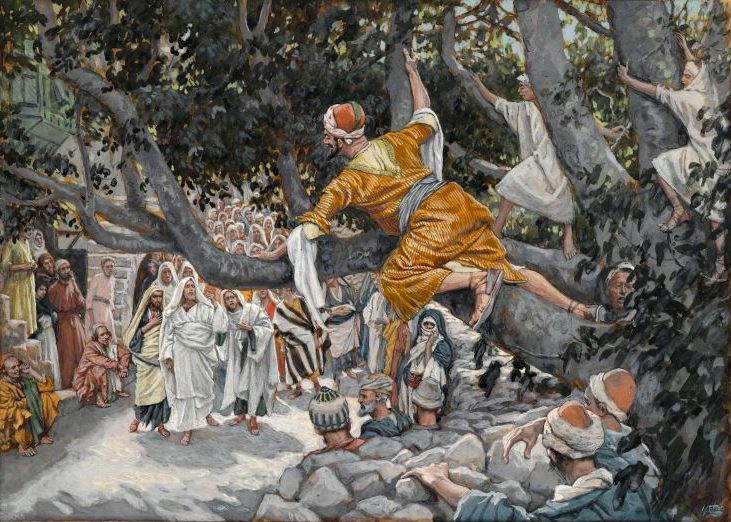
Jesus is walking through Jericho.3 A man called Zacchaeus wants to see him, but he is the chief of the tax collectors, he is short, and the crowd is in the way.4
So he runs ahead and climbs a sycamore tree.5 Jesus reaches the spot, looks up, and calls him by name: “Zacheus, make haste and come down: for this day I must abide in thy house.”6
The crowd starts to mutter. Zacchaeus is about to say something nobody expected.
01The basics
What confession is
Zacchaeus comes down “with joy.”7 Standing in front of everyone, he promises to give half his goods to the poor and to repay anyone he has wronged four times over.8 Jesus answers: “This day is salvation come to this house.”9
Confession is the sacrament where you tell your sins to a priest and receive God’s pardon and peace.1 Only God forgives sins, and Jesus gave this power to men to exercise in his name.10
“When he had said this, he breathed on them; and he said to them: Receive ye the Holy Ghost. Whose sins you shall forgive, they are forgiven them: and whose sins you shall retain, they are retained.”
So what actually happens when you walk in? Fewer steps than you might fear.
02The walk-through
What happens, one step at a time
If it has been years, or you have never been, you do not need to remember any of this. Just say, “It has been a long time. Can you help me?” The priest will guide you through it.
<b>1. Greeting:</b> the priest greets and blesses you.14
<b>2. A reading:</b> sometimes a short passage from the Bible is read, to help you look at your life honestly.14
<b>3. Your confession:</b> you tell the priest your sins, in plain words.14
<b>4. A penance:</b> the priest gives you something small to do, often a prayer, an offering, or an act of kindness.1415
<b>5. Absolution:</b> the priest says the words of forgiveness, ending, “I absolve you from your sins in the name of the Father, and of the Son and of the Holy Spirit.”16
<b>6. Go in peace:</b> a prayer of thanks, and the priest sends you off with a blessing.14
But what if you are not sure you are sorry enough? Or you cannot remember everything?
03The heart of it
Sorrow, not perfection
What the Church asks is contrition: real sorrow for the sin, together with the resolution not to sin again.18
You bring the serious sins you are aware of after an honest look at your life. If you try to confess all the sins you can remember, you place all of them before God’s mercy.19
The Catechism gives a simple reason for saying them out loud: “if the sick person is too ashamed to show his wound to the doctor, the medicine cannot heal what it does not know.”19
“If we confess our sins, he is faithful and just, to forgive us our sins and to cleanse us from all iniquity.”
And the fear underneath all of that: what will the priest think, and will he tell anyone?
04The promise
The seal, and the priest
Every priest who hears confessions is bound, under very severe penalties, to keep absolute secrecy about what you confess. This secret admits of no exceptions, and it is called the sacramental seal.2
The Church asks confessors to show “respect and sensitivity toward the one who has fallen.” The confessor is not the master of God’s forgiveness, but its servant.22
In this sacrament the priest fulfils the ministry of the Father who waits for the prodigal son and welcomes him home.23
“And rising up, he came to his father. And when he was yet a great way off, his father saw him and was moved with compassion and running to him fell upon his neck and kissed him.”
Zacchaeus climbed a tree just to catch a glimpse. Jesus was the one who stopped.
Your move
Try this, this week
- Read Luke 19:1-10. Notice who moves first.
- Use our examination of conscience the day before, slowly.
- Bring the Act of Contrition on paper. That is allowed.
- Go at a quiet time, or call the parish to ask for an appointment.
You’ll need
- Confession times for a nearby parish.
- Ten minutes to examine your conscience first.
Remember Say it has been a long time. The priest will help.
Optional: watch a short film
Video: Going to Confession for the First Time in a Long Time, Ascension Presents (Ascension). Link checked 4 October 2026. Loads from YouTube (privacy-enhanced mode) only when you press play. Watch on YouTube
What this video covers (summarized from the publisher’s description, not a transcript): Fr. Mike Schmitz explains how to approach going to confession when it has been a long time, whether a year or a lifetime, and says God is ready and willing to forgive.
What the Church teaches on this: There is no offense, however serious, that the Church cannot forgive. CCC 982
Videos come from faithful Catholic teachers. Where a video and this page differ in wording, the Catechism and Scripture cited here are the authority.
If this is hard
If confession feels frightening, you are far from the first. Tell the priest it has been a long time and that you are nervous; he is there to help. If you have a question you are afraid to ask in confession, ask for a conversation first.
Two questions people ask
What if I cannot remember all my sins?
The Church says that when the faithful strive to confess all the sins that they can remember, they undoubtedly place all of them before the divine mercy for pardon.19
Will the priest tell anyone?
Every priest who hears confessions is bound under very severe penalties to keep absolute secrecy regarding the sins confessed to him. He can make no use of knowledge that confession gives him about penitents’ lives.2
Can I receive Communion before I go to confession?
Anyone aware of having committed a mortal sin must not receive Holy Communion without first receiving sacramental absolution, unless he has a grave reason and there is no possibility of going to confession.25 Perfect contrition obtains forgiveness of mortal sins if it includes the firm resolution to have recourse to sacramental confession as soon as possible.26
Do I have to confess small, everyday sins?
Confession of everyday faults, called venial sins, is not strictly necessary, but the Church strongly recommends it.27
Only one thing to do
Your one next step
Look up the confession times at one nearby parish and put one in your calendar. You do not have to go yet. If you would like to prepare, our confession guide walks you through it, one calm step at a time.
Open the confession guideStep 4 of 7 · Fallen-away Catholic
After confession, what is it like to go back to Mass?
Take it with you
Printable one-page cardDownload card (A4 PDF)Download card (US Letter PDF)Short link: stoneandincense-preview.pages.dev/go/ch4
Notes
- Catechism of the Catholic Church, paragraph 1424. vatican.va
- Catechism of the Catholic Church, paragraph 1467. vatican.va
- Luke 19:1, Douay-Rheims. read the chapter
- Luke 19:2-3, Douay-Rheims. read the chapter
- Luke 19:4, Douay-Rheims. read the chapter
- Luke 19:5, Douay-Rheims. read the chapter
- Luke 19:6, Douay-Rheims. read the chapter
- Luke 19:8, Douay-Rheims. read the chapter
- Luke 19:9, Douay-Rheims. read the chapter
- Catechism of the Catholic Church, paragraph 1441. vatican.va
- John 20:22-23, Douay-Rheims. read the chapter
- Catechism of the Catholic Church, paragraph 1131. vatican.va
- Catechism of the Catholic Church, paragraph 1423. vatican.va
- Catechism of the Catholic Church, paragraph 1480. vatican.va
- Catechism of the Catholic Church, paragraph 1460. vatican.va
- Catechism of the Catholic Church, paragraph 1449. vatican.va
- Catechism of the Catholic Church, paragraph 1459. vatican.va
- Catechism of the Catholic Church, paragraph 1451. vatican.va
- Catechism of the Catholic Church, paragraph 1456. vatican.va
- 1 John 1:9, Douay-Rheims. read the chapter
- Catechism of the Catholic Church, paragraph 1855. vatican.va
- Catechism of the Catholic Church, paragraph 1466. vatican.va
- Catechism of the Catholic Church, paragraph 1465. vatican.va
- Luke 15:20, Douay-Rheims. read the chapter
- Catechism of the Catholic Church, paragraph 1457. vatican.va
- Catechism of the Catholic Church, paragraph 1452. vatican.va
- Catechism of the Catholic Church, paragraph 1458. vatican.va
Excerpts from the English translation of the Catechism of the Catholic Church for use in the United States of America Copyright © 1994, United States Catholic Conference, Inc. – Libreria Editrice Vaticana. Used with Permission. English translation of the Catechism of the Catholic Church: Modifications from the Editio Typica copyright © 1997, United States Conference of Catholic Bishops – Libreria Editrice Vaticana. Scripture: Douay-Rheims, Challoner revision (public domain). Early Christian writers: Ante-Nicene Fathers (1885, public domain). Video: “Going to Confession for the First Time in a Long Time,” Ascension Presents, supporting material, not a teaching source.
Scenes marked “Imagine” are an invitation to picture the moment, not a historical record. Stone & Incense restates Church teaching in plain words; our wording is not an official Church text. Report an error.