
Journeys / Becoming Catholic / Step 3 of 6
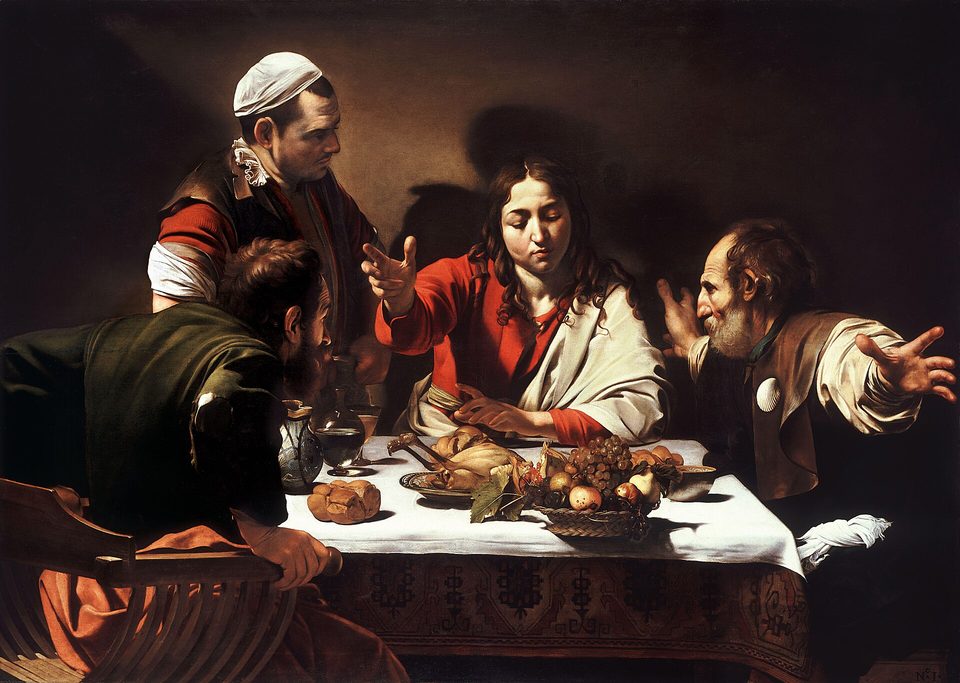
The road to Emmaus, the first Easter evening
On the evening of the first Easter, two of Jesus’ followers are walking to a village called Emmaus, talking about everything that has happened.3 A stranger falls into step beside them and asks why they are so sad.4
It is Jesus, risen.5 But “their eyes were held, that they should not know him.”6
They walk for miles with him and still do not recognise him. What finally opens their eyes is not an argument.
01The moment
Known in the breaking of bread
At the village they beg him: “Stay with us, because it is towards evening and the day is now far spent.”7
“And it came to pass, whilst he was at table with them, he took bread and blessed and brake and gave to them. And their eyes were opened: and they knew him. And he vanished out of their sight.”
Later they tell the others “how they knew him in the breaking of bread.”9
Not in a lecture. In bread, blessed, broken and handed to them. Something they could see, and hold, and eat.
That turns out to be how Jesus works. Again and again.
02The pattern
He touched people
When Jesus raised a little girl, he took her by the hand and said, “Talitha cumi,” which means, “Damsel (I say to thee) arise.”10
He did not just think good thoughts at people. He used hands, words, water, bread.
The Church teaches that what Jesus did during his life on earth is the foundation of what he now gives in the sacraments.11 They are signs we can perceive, words and actions suited to human beings like us.12
So are they just beautiful symbols? The Church says no, and the reason is surprising.
03The claim
Not magic, and not just symbols
Celebrated worthily in faith, the sacraments give the grace they signify, because “in them Christ himself is at work.”14
Here is the surprising part: they do not depend on how holy the priest is. They work by the power of what Christ did, once for all.15
They are not magic either: what they bear in your life also depends on the heart you bring to them.15
There are seven. Together they cover a whole life, from the first day to the last.
04The seven
From the first day to the last
The seven sacraments touch every stage and every important moment of a Christian life.2
<b>Three to begin.</b> Baptism, the doorway, which frees us from sin and makes us members of Christ.16 Confirmation, which completes it with a special strength of the Holy Spirit.1718 The Eucharist, Christ’s own Body and Blood, the source and summit of the Christian life.1920
<b>Two to heal.</b> Confession, also called Penance or Reconciliation, where we receive God’s pardon and are reconciled with the Church.21 The Anointing of the Sick, in which the whole Church entrusts those who are seriously ill to the Lord.22
<b>Two to serve.</b> Holy Orders, through which the mission Christ gave his apostles continues.23 Matrimony, the covenant in which a man and a woman form a partnership of their whole life.24
“When he had said this, he breathed on them; and he said to them: Receive ye the Holy Ghost. Whose sins you shall forgive, they are forgiven them: and whose sins you shall retain, they are retained.”
Which raises the practical question: if you are starting from zero, where do you come in?
05Where you come in
If you are becoming Catholic
For adults who have never been baptized, the path begins with a time of preparation called the catechumenate, and reaches its high point in one celebration of Baptism, Confirmation and the Eucharist.26
If you were already baptized as a Christian, you are not baptized again: “Given once for all, Baptism cannot be repeated.”27
Every parish does this a little differently, and the names vary from country to country. You do not need to work it out alone. Your parish will walk you through it.
Two friends at Emmaus knew him in the breaking of bread. All seven sacraments lead to that same table.
Your move
Try this, this week
- Read Luke 24:13-35. The whole Emmaus story. Notice when their eyes open.
- Go to one Mass and watch. You do not need to know the responses. If you are not Catholic, you are welcome to stay seated during Communion.
- Find your baptism record, if you were baptized. Your parish will ask for it when you are ready.
- Ask a priest about the sacrament you understand least.
You’ll need
- A Bible, open to John 6 and Luke 22.
- If you can, one visit to a Mass in your area.
Remember Christ meets us in signs we can see and touch.
Optional: watch a short film
Video: Bishop Barron on “The Sacraments”, Bishop Robert Barron (Word on Fire). Link checked 4 October 2026. Loads from YouTube (privacy-enhanced mode) only when you press play. Watch on YouTube
What this video covers (summarized from the publisher’s description, not a transcript): Bishop Robert Barron introduces his series on the sacraments: everything in the Church’s life comes from and returns to them, and their lasting power is the presence of the Savior himself.
What the Church teaches on this: The Catechism teaches that in the sacraments Christ himself is at work. CCC 1127
Videos come from faithful Catholic teachers. Where a video and this page differ in wording, the Catechism and Scripture cited here are the authority.
If this is hard
If some sacraments raise worries for you, such as confession or a marriage situation, you are not the first. These are exactly the questions a priest is there for. Ask privately; you will not be put on the spot.
Two questions people ask
Are the sacraments just symbols?
The Church teaches that they are efficacious: celebrated worthily in faith, they confer the grace that they signify, because Christ himself is at work in them.14 They act by the power of Christ’s saving work, not by the personal holiness of the minister.15
Is the Eucharist really Jesus?
The Church teaches that in the Eucharist “the body and blood, together with the soul and divinity, of our Lord Jesus Christ and, therefore, the whole Christ is truly, really, and substantially contained.”20 Jesus said, “For my flesh is meat indeed: and my blood is drink indeed.”28
Only one thing to do
Your one next step
Read the Emmaus story tonight, Luke 24:13-35. It takes about five minutes. Notice the moment their eyes open.
Read Luke 24Step 3 of 6 · Becoming Catholic
All seven sacraments flow toward one table. What actually happens at Mass, and why do Catholics go every Sunday?
Step 4: The MassTake it with you
Printable one-page cardDownload card (A4 PDF)Download card (US Letter PDF)Short link: stoneandincense-preview.pages.dev/go/bc3
Notes
- Catechism of the Catholic Church, paragraph 1131. vatican.va
- Catechism of the Catholic Church, paragraph 1210. vatican.va
- Luke 24:13-14, Douay-Rheims. read the chapter
- Luke 24:15-17, Douay-Rheims. read the chapter
- Luke 24:15, Douay-Rheims. read the chapter
- Luke 24:16, Douay-Rheims. read the chapter
- Luke 24:29, Douay-Rheims. read the chapter
- Luke 24:30-31, Douay-Rheims. read the chapter
- Luke 24:35, Douay-Rheims. read the chapter
- Mark 5:41, Douay-Rheims. read the chapter
- Catechism of the Catholic Church, paragraph 1115. vatican.va
- Catechism of the Catholic Church, paragraph 1084. vatican.va
- Catechism of the Catholic Church, paragraph 1996. vatican.va
- Catechism of the Catholic Church, paragraph 1127. vatican.va
- Catechism of the Catholic Church, paragraph 1128. vatican.va
- Catechism of the Catholic Church, paragraph 1213. vatican.va
- Catechism of the Catholic Church, paragraph 1285. vatican.va
- Catechism of the Catholic Church, paragraph 1303. vatican.va
- Catechism of the Catholic Church, paragraph 1324. vatican.va
- Catechism of the Catholic Church, paragraph 1374. vatican.va
- Catechism of the Catholic Church, paragraph 1422. vatican.va
- Catechism of the Catholic Church, paragraph 1499. vatican.va
- Catechism of the Catholic Church, paragraph 1536. vatican.va
- Catechism of the Catholic Church, paragraph 1601. vatican.va
- John 20:22-23, Douay-Rheims. read the chapter
- Catechism of the Catholic Church, paragraph 1233. vatican.va
- Catechism of the Catholic Church, paragraph 1272. vatican.va
- John 6:56, Douay-Rheims. read the chapter
- Catechism of the Catholic Church, paragraph 1441. vatican.va
- Catechism of the Catholic Church, paragraph 1461. vatican.va
Excerpts from the English translation of the Catechism of the Catholic Church for use in the United States of America Copyright © 1994, United States Catholic Conference, Inc. – Libreria Editrice Vaticana. Used with Permission. English translation of the Catechism of the Catholic Church: Modifications from the Editio Typica copyright © 1997, United States Conference of Catholic Bishops – Libreria Editrice Vaticana. Scripture: Douay-Rheims, Challoner revision (public domain). Early Christian writers: Ante-Nicene Fathers (1885, public domain). Video: “Bishop Barron on “The Sacraments”,” Bishop Robert Barron, supporting material, not a teaching source.
Scenes marked “Imagine” are an invitation to picture the moment, not a historical record. Stone & Incense restates Church teaching in plain words; our wording is not an official Church text. Report an error.