
Journeys / Becoming Catholic / Step 4 of 6
Rome, around AD 155
A Christian named Justin is writing a letter to the emperor of Rome, Antoninus Pius.1
His people, he writes, are “unjustly hated and wantonly abused.”2
He could have stayed vague. Instead he tells the most powerful man on earth exactly what Christians do when they meet.
01The letter
What Justin told the emperor
“And on the day called Sunday, all who live in cities or in the country gather together to one place, and the memoirs of the apostles or the writings of the prophets are read, as long as time permits; then, when the reader has ceased, the president verbally instructs, and exhorts to the imitation of these good things. Then we all rise together and pray, and, as we before said, when our prayer is ended, bread and wine and water are brought, and the president in like manner offers prayers and thanksgivings, according to his ability, and the people assent, saying Amen”
Readings. A sermon. Everyone standing to pray. Bread and wine. A long thanksgiving. A room saying “Amen.” If you have ever been to a Mass, the Catholic Sunday service, you just felt the jolt. That is next Sunday, written down almost nineteen centuries ago.
The Catechism quotes this letter and says its basic lines “have stayed the same until our own day for all the great liturgical families.”1
Which raises the real question. Why keep doing the same thing, every week, for nearly nineteen hundred years?
02The stakes
Why this is not just a nice tradition
Be honest. For many people, “Mass” means an hour of standing, sitting and kneeling, always half a second behind everyone else.
The Church calls the Eucharist “the source and summit of the Christian life.” Why? Because in it “is contained the whole spiritual good of the Church, namely Christ himself.”10
If the Church is right, the most important thing in the world happens every Sunday, a short walk from your front door. If she is wrong, this is the strangest habit in history. There is no comfortable middle.
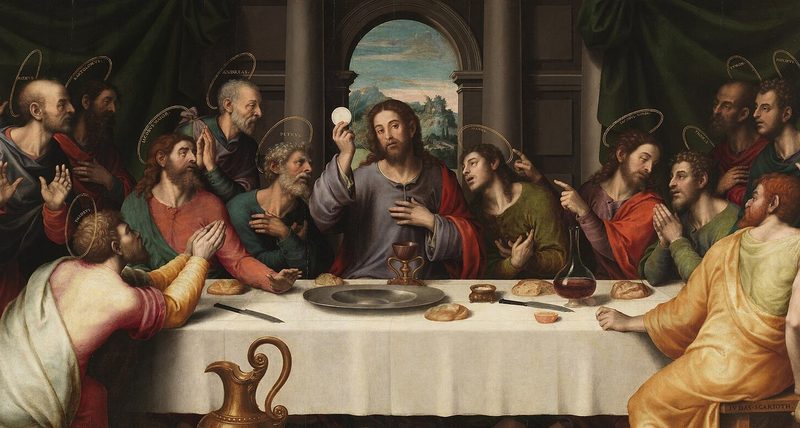
It started in one room in Jerusalem, on the night Jesus was betrayed.
03The night it started
This is my body
Jesus sent Peter and John ahead to prepare the Passover meal.11 They were shown “a large dining room, furnished.”12
ImagineLamps. A crowded table. A meal these men knew by heart. Then Jesus changes the script.
“And taking bread, he gave thanks and brake and gave to them, saying: This is my body, which is given for you. Do this for a commemoration of me. In like manner, the chalice also, after he had supped, saying: This is the chalice, the new testament in my blood, which shall be shed for you.”
Notice what he does not say. Not “this is like my body.” Not “this stands for it.”
He says, “This is my body.” Then an order: “Do this for a commemoration of me.”14
That night, the Church teaches, Jesus instituted the Eucharist to perpetuate the sacrifice of the cross until he comes again.15 Christians have obeyed ever since, in a form whose substance has not changed.16
Did the first Christians really take him at his word? We do not have to guess. We have their letters.
04The evidence
What a bishop wrote in AD 107
Around AD 107, Bishop Ignatius of Antioch warned the Christians of Smyrna about a group of heretics. His charge is precise: “They abstain from the Eucharist and from prayer, because they confess not the Eucharist to be the flesh of our Saviour Jesus Christ, which suffered for our sins, and which the Father, of His goodness, raised up again.”17
Less than a century after the crucifixion, the dividing line was already this one. Is it really his flesh, or not?
Half a century later Justin tells the emperor the same thing: “not as common bread and common drink do we receive these,” but as “the flesh and blood of that Jesus who was made flesh.”18
Jesus himself had put it bluntly.
“Then Jesus said to them: Amen, amen, I say unto you: except you eat the flesh of the Son of man and drink his blood, you shall not have life in you.”
The Church teaches the same today: in the Eucharist “the whole Christ is truly, really, and substantially contained.”20 The whole substance of the bread and wine becomes his body and blood, a change called transubstantiation.21
That leaves the word that makes many people wince. Sacrifice.
05The objection
Once for all, and here
You may have heard it: “Catholics think they sacrifice Jesus over and over.”
They do not. The Church teaches that “the sacrifice of Christ and the sacrifice of the Eucharist are one single sacrifice.” The same Christ who offered himself once in a bloody manner on the cross is offered in the Mass in an unbloody manner.22
The Mass makes present the sacrifice of the cross, is its memorial, and applies its fruit.23 Not a second Calvary.22 The same one, made present.23
Which is why Catholics are so stubborn about Sunday.
06The day
Why every Sunday
Sunday is the day of the Resurrection, kept “by a tradition handed down from the apostles.”24
The Church calls the Sunday Eucharist “the foundation and confirmation of all Christian practice,” and asks Catholics to be there on Sundays and holy days unless excused for a serious reason, such as illness or the care of infants.2526
Not Catholic yet? You are welcome at any Mass. Sit, watch, take it in. When others go up for Communion, simply stay in your seat.
One last line from Justin. Most people skip it. It is the best part.
07The ending
It ends at the door
Justin’s Sunday does not end at the altar: “to those who are absent a portion is sent by the deacons.” Then a collection goes to the one presiding, “who succours the orphans and widows.”3
That is the whole shape of it. You gather. You listen. You give thanks. Then it goes out the door, to the people who could not be in the room.
Sunday is one hour of your week. That leaves a hundred and sixty-seven.
Your move
Try this, this week
- Read the night it started. Luke 22:14-20, then 1 Corinthians 11:23-26.
- Go to one Sunday Mass with Justin’s list in your pocket. Tick off each part as it happens.
- Arrive ten minutes early. Sit. Watch how people come in.
- Not Catholic? Stay seated during Communion. You are still fully welcome.
You’ll need
- A Bible, open to Luke 22 and 1 Corinthians 11.
- The time of a Sunday Mass near you.
Remember Jesus said, “Do this.” The Church has done it every Sunday since.
Optional: watch a short film
Video: The Mass Explained: More Than a Meal, More Than a Celebration (feat. Michael Gormley), Ascension Presents (Ascension). Link checked 4 October 2026. Loads from YouTube (privacy-enhanced mode) only when you press play. Watch on YouTube
What this video covers (summarized from the publisher’s description, not a transcript): Michael Gormley explains why the Mass is called a sacrifice, what makes it essential, and how we are invited to take part in it.
What the Church teaches on this: The Church teaches that the Eucharist is a sacrifice because it re-presents (makes present) the sacrifice of the cross. CCC 1366
Videos come from faithful Catholic teachers. Where a video and this page differ in wording, the Catechism and Scripture cited here are the authority.
If this is hard
If Mass feels long or foreign at first, that is normal. Many people need months before it feels like home. If something about it hurts, a priest can talk it through with you in private.
Two questions people ask
Can I receive Communion if I am not Catholic?
The usual answer is no: Catholic ministers give the sacraments licitly “to Catholic members of the Christian faithful alone,” with exceptions the same canon lists.27 Justin gave the rule in 155: no one may take part “unless he believes that what we teach is true, has received baptism for the forgiveness of sins and new birth, and lives in keeping with what Christ taught.”28 The same canon allows narrow exceptions, for Orthodox Christians and in danger of death or grave necessity.272930 The Church feels this division keenly and prays for unity.31
Only one thing to do
Your one next step
Pick one Sunday Mass near you. Sit anywhere, and open our “In the pew” guide on your phone. It walks you through, one calm step at a time. Nobody will ask you anything.
Open the In the pew guideStep 4 of 6 · Becoming Catholic
The Mass is the Church’s great prayer. But how do you pray on an ordinary Tuesday, alone, when you do not know what to say?
Step 5: PrayerTake it with you
Printable one-page cardDownload card (A4 PDF)Download card (US Letter PDF)Short link: stoneandincense-preview.pages.dev/go/bc4
Notes
- Catechism of the Catholic Church, paragraph 1345. vatican.va
- St. Justin Martyr, First Apology 1-2 (c. 155). Ante-Nicene Fathers vol. 1 (1885). newadvent.org
- St. Justin Martyr, First Apology 67 (c. 155). Ante-Nicene Fathers vol. 1 (1885). ccel.org
- Catechism of the Catholic Church, paragraph 1332. vatican.va
- Catechism of the Catholic Church, paragraph 1131. vatican.va
- Catechism of the Catholic Church, paragraph 1113. vatican.va
- Catechism of the Catholic Church, paragraph 1328. vatican.va
- Catechism of the Catholic Church, paragraph 1331. vatican.va
- Catechism of the Catholic Church, paragraph 1548. vatican.va
- Catechism of the Catholic Church, paragraph 1324. vatican.va
- Luke 22:8, Douay-Rheims. read the chapter
- Luke 22:12, Douay-Rheims. read the chapter
- Luke 22:19-20, Douay-Rheims. read the chapter
- Luke 22:19, Douay-Rheims. read the chapter
- Catechism of the Catholic Church, paragraph 1323. vatican.va
- Catechism of the Catholic Church, paragraph 1356. vatican.va
- St. Ignatius of Antioch, Letter to the Smyrnaeans 7-8 (c. 107-110). Ante-Nicene Fathers vol. 1 (1885). newadvent.org
- St. Justin Martyr, First Apology 66 (c. 155). Ante-Nicene Fathers vol. 1 (1885). newadvent.org
- John 6:54, Douay-Rheims. read the chapter
- Catechism of the Catholic Church, paragraph 1374. vatican.va
- Catechism of the Catholic Church, paragraph 1376. vatican.va
- Catechism of the Catholic Church, paragraph 1367. vatican.va
- Catechism of the Catholic Church, paragraph 1366. vatican.va
- Catechism of the Catholic Church, paragraph 1166. vatican.va
- Catechism of the Catholic Church, paragraph 2181. vatican.va
- Catechism of the Catholic Church, paragraph 2180. vatican.va
- Code of Canon Law, can. 844. vatican.va, English translation. vatican.va
- Catechism of the Catholic Church, paragraph 1355. vatican.va
- Catechism of the Catholic Church, paragraph 1399. vatican.va
- Catechism of the Catholic Church, paragraph 1401. vatican.va
- Catechism of the Catholic Church, paragraph 1398. vatican.va
- Catechism of the Catholic Church, paragraph 1385. vatican.va
- Catechism of the Catholic Church, paragraph 1389. vatican.va
Excerpts from the English translation of the Catechism of the Catholic Church for use in the United States of America Copyright © 1994, United States Catholic Conference, Inc. – Libreria Editrice Vaticana. Used with Permission. English translation of the Catechism of the Catholic Church: Modifications from the Editio Typica copyright © 1997, United States Conference of Catholic Bishops – Libreria Editrice Vaticana. Scripture: Douay-Rheims, Challoner revision (public domain). Early Christian writers: Ante-Nicene Fathers (1885, public domain). Video: “The Mass Explained: More Than a Meal, More Than a Celebration (feat. Michael Gormley),” Ascension Presents, supporting material, not a teaching source.
Scenes marked “Imagine” are an invitation to picture the moment, not a historical record. Stone & Incense restates Church teaching in plain words; our wording is not an official Church text. Report an error.