.jpg)
Mount Sinai
At Sinai God gives the commandment: no graven thing, and no likeness to adore or serve.5
A few chapters later he gives Moses instructions for the ark: “Thou shalt make also two cherubims of beaten gold.”6 And he promises to speak to Moses “from the midst of the two cherubims.”7
Same God, same book, same Moses. So the commandment must mean something more exact than a ban on every image.
01Your verse first
“Thou shalt not make to thyself a graven thing”
“Thou shalt not make to thyself a graven thing, nor the likeness of any thing that is in heaven above, or in the earth beneath, nor of those things that are in the waters under the earth. Thou shalt not adore them, nor serve them: I am the Lord thy God, mighty, jealous, visiting the iniquity of the fathers upon the children, unto the third and fourth generation of them that hate me:”
Read fairly: God forbids making images and bowing to them. Statues in churches and people kneeling before icons look like exactly what the commandment forbids.
Catholics agree idolatry is forbidden. Look at what else God commanded.
02The Catholic reading
Images God commanded
Already in the Old Testament, the Catechism says, God ordered or permitted images that pointed toward salvation: the bronze serpent, the ark of the covenant, and the cherubim.2
“And the Lord said to him: Make a brazen serpent, and set it up for a sign: whosoever being struck shall look on it, shall live. Moses therefore made a brazen serpent, and set it up for a sign: which when they that were bitten looked upon, they were healed.”
Jesus himself pointed to that serpent as a sign of his own cross.9 Solomon’s Temple had cherubim and palm trees carved on its walls.10
Then something happened that changed what an image of God could be.
03The turn
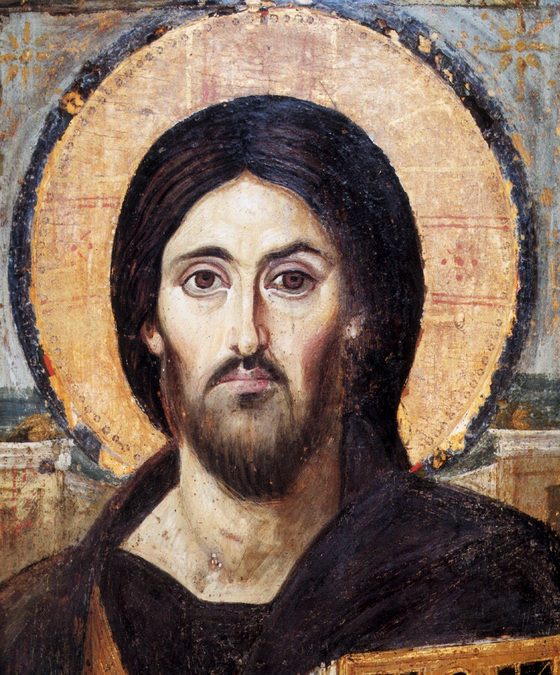
The image of the invisible God
“Who is the image of the invisible God, the firstborn of every creature:”
The Old Law forbade picturing God because Israel saw no form of him at Horeb.1
In Christ the invisible God became visible: “he that seeth me seeth the Father also.”12 By becoming incarnate, the Catechism says, the Son of God introduced a new “economy” of images, and the Second Council of Nicaea in 787 defended the veneration of icons on that basis.3
So what is happening when a Catholic kneels before a statue?
04The real disagreement
Where we think it lies
Not whether idolatry is wrong; both sides agree on that. The question is whether honour shown to an image stops at the image or passes to the person it shows.
The Church answers that “the honor rendered to an image passes to its prototype.” It is a “respectful veneration,” not the adoration due to God alone. Religious worship is not directed to images in themselves, as mere things, but to images as leading us on to God.4
A family photograph is a fair comparison. Nobody kisses a photograph of their mother because they think the paper is their mother.
The God who forbade idols also said: make two cherubim. He knew the difference.
Careful with the facts
- The Church teaches that the veneration of images is never adoration, which is due to God alone.4
Christian to Christian
Catholics and Protestants share the conviction that God alone is to be worshipped. This question is about how that worship is helped, not about whom it belongs to.
Only one thing to do
Your one next step
Read Exodus 25:17-22 next to Exodus 20:4-5. Ask what made the cherubim on the ark different from the golden calf.
Read Exodus 25Keep going
Notes
- Catechism of the Catholic Church, paragraph 2129. vatican.va
- Catechism of the Catholic Church, paragraph 2130. vatican.va
- Catechism of the Catholic Church, paragraph 2131. vatican.va
- Catechism of the Catholic Church, paragraph 2132. vatican.va
- Exodus 20:4-5, Douay-Rheims. read the chapter
- Exodus 25:18, Douay-Rheims. read the chapter
- Exodus 25:22, Douay-Rheims. read the chapter
- Numbers 21:8-9, Douay-Rheims. read the chapter
- John 3:14, Douay-Rheims. read the chapter
- 3 Kings 6:29, Douay-Rheims. read the chapter
- Colossians 1:15, Douay-Rheims. read the chapter
- John 14:9, Douay-Rheims. read the chapter
Translations of the Fathers and councils are public-domain 19th-century editions. Catechism links open vatican.va. Scripture: Douay-Rheims, Challoner revision. Stone & Incense restates Church teaching and history in plain words; our wording is not an official Church text. Report an error.