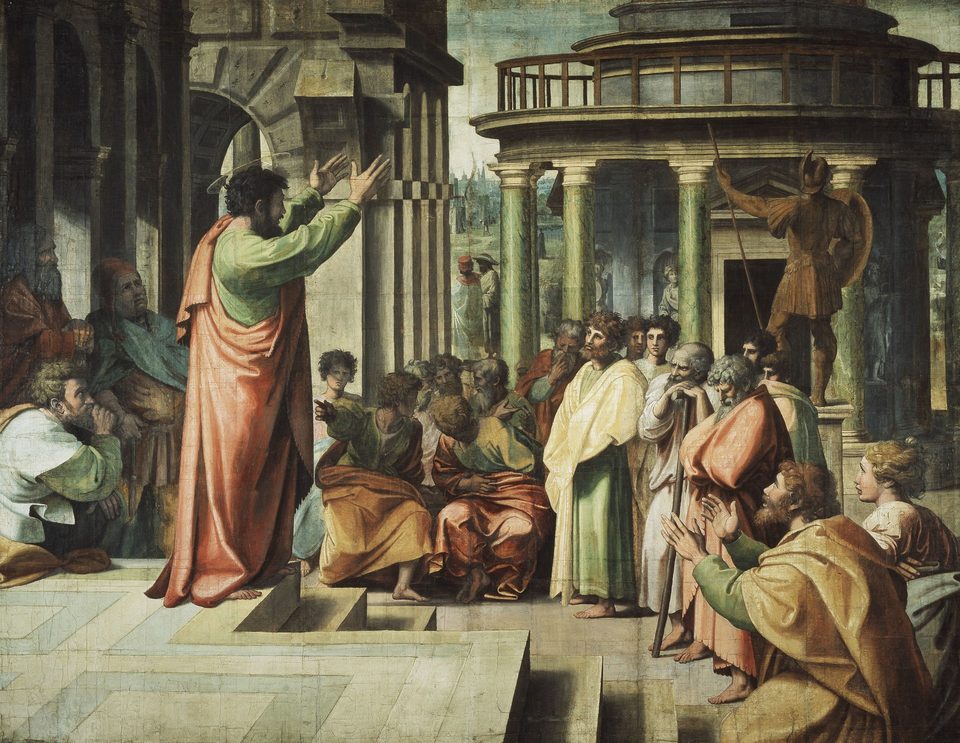

Cappadocia, in modern Turkey, at the funeral of St Basil
St Gregory Nazianzen is giving the funeral speech for his friend, St Basil the Great. At one point he says: “A noble thing is philanthropy, and the support of the poor, and the assistance of human weakness.”3
Then he tells his listeners to walk out of town: “Go forth a little way from the city, and behold the new city, the storehouse of piety.”3
What was waiting outside the city? To understand it, start with something Jesus said.
01The reason
Why Christians cared
“Naked, and you covered me: sick, and you visited me: I was in prison, and you came to me.”
The Catechism says Christ’s love for the sick has not ceased through the centuries to draw the very special attention of Christians toward all those who suffer.5
“And the king answering shall say to them: Amen I say to you, as long as you did it to one of these my least brethren, you did it to me.”
Basil took that literally, and built it in stone.
02Around the year 370
Basil’s “new city”
Britannica records that about 370 St Basil the Great established a foundation in Cappadocia “that included a hospital, an isolation unit for those suffering from leprosy, and buildings to house the poor, the elderly, and the sick.”1
Following this example, similar hospitals were later built in the eastern part of the Roman Empire.1
“Go forth a little way from the city, and behold the new city, the storehouse of piety, the common treasury of the wealthy.”
In the West, the same care often lived behind monastery walls.
03The monasteries
Monasteries
Britannica notes that monasteries often housed infirmaries and provided medical care.1
And the monks and clergy were not only caring for bodies. They were teaching.
04The 11th to 13th centuries
The first universities
According to Britannica, the earliest studia “arose out of efforts to educate clerks and monks beyond the level of the cathedral and monastic schools.”2
Bologna was founded late in the 11th century and Paris between 1150 and 1170, and the University of Toulouse, founded by Pope Gregory IX in 1229, was the first established by papal decree.2
A hospital outside a city in Cappadocia, a lecture hall in Bologna. Both grew up in the life of the Church, and both are still with us.
Careful with the facts
- Care for the sick is older than Christianity: Britannica notes earlier hospitals, such as those the Romans set up for sick and injured soldiers.1
- Britannica also notes that universities existed in some parts of Asia and Africa in ancient times; the medieval university of Europe was a new kind of institution.2
Christian to Christian
This is a shared Christian inheritance. Christians of many traditions have founded hospitals and universities since, and still do.
Watch
Day 205: Christ the Physician (The Catechism in a Year)Fr. Mike Schmitz · The Catechism in a Year · 22 minThis channel plays its videos on YouTube only.
From the official channels of the teachers named. Links checked 4 October 2026; an editor has not yet watched every video in full. Scripture and the Catechism cited on this page are the authority. All videos by topic.
Only one thing to do
Your one next step
Read Matthew 25:31-46, the passage behind Basil’s new city. Then think of one person you know who is sick or alone, and get in touch with them this week.
Read Matthew 25Keep going
Notes
- Encyclopaedia Britannica, “Hospital”. reference work. britannica.com
- Encyclopaedia Britannica, “University”. reference work. britannica.com
- St. Gregory Nazianzen, Oration 43 (funeral oration for St. Basil), 63 (c. 381). Nicene and Post-Nicene Fathers, 2nd series, vol. 7 (1894). newadvent.org
- Matthew 25:36, Douay-Rheims. read the chapter
- Catechism of the Catholic Church, paragraph 1503. vatican.va
- Matthew 25:40, Douay-Rheims. read the chapter
Translations of the Fathers and councils are public-domain 19th-century editions. Catechism links open vatican.va. Scripture: Douay-Rheims, Challoner revision. Stone & Incense restates Church teaching and history in plain words; our wording is not an official Church text. Report an error.