
Home / The saints / St Benedict
A cave at Subiaco, about 500
A young man leaves Rome in secret for a wild place called Subiaco, almost forty miles away.1
He lives in a narrow cave, and for three years no one knows he is there except a monk named Romanus.1
Romanus lowers bread to him on a long rope from the rock above, with a little bell tied on so he will hear it coming.1
His name was Benedict. Monks living by his rule would carry learning and prayer across a collapsing continent.
Patron of Europe2
01St Benedict
From cave to mountain
Pope St Gregory the Great, who wrote his life, says Benedict chose to be wearied with labour for God rather than praised by men.1
Disciples gathered around him, and he later founded the monastery of Monte Cassino.1
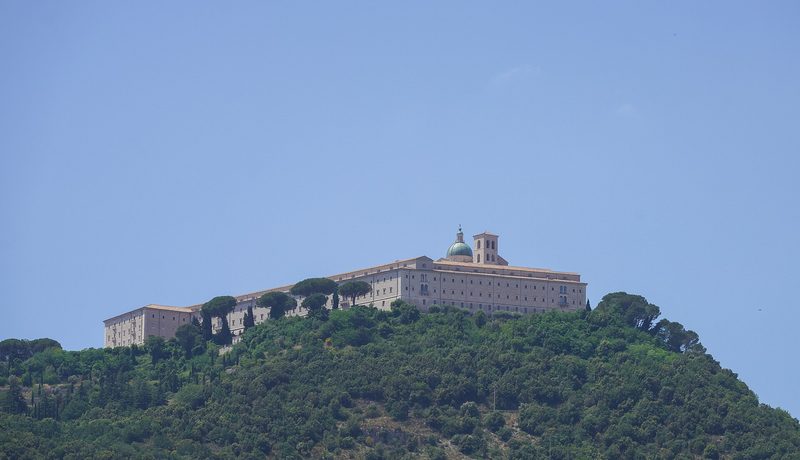
02St Benedict
Patron of Europe
Six days before he died he had his grave opened; on the sixth day, held up by his monks in the oratory, he received the Body and Blood of Christ and died standing, his hands lifted to heaven.1
St John Paul II recalled that St Benedict is the patron of Europe, joined in 1980 by Sts Cyril and Methodius.2
Pray and work. Two words, a short rule, and fifteen centuries of monasteries.
Notes
- St Gregory the Great, Dialogues, Book II: the Life of St Benedict (c. 593). 1608 translation, revised by E. G. Gardner (1911). tertullian.org
- Pope St John Paul II, Apostolic Letter Spes Aedificandi, proclaiming co-patronesses of Europe, 1 October 1999. Holy See, official English text. vatican.va
The Catholic Encyclopedia (1913) is in the public domain; we quote the New Advent edition. Texts of the Holy See are quoted briefly from vatican.va. Scripture: Douay-Rheims, Challoner revision (public domain). Photographs: Wikimedia Commons, credited under each image; full list on the photo credits page.
Lines in the narrator’s voice, without a note, are our reflection, not a historical claim. Stone & Incense restates Church teaching in plain words; our wording is not an official Church text. Report an error.