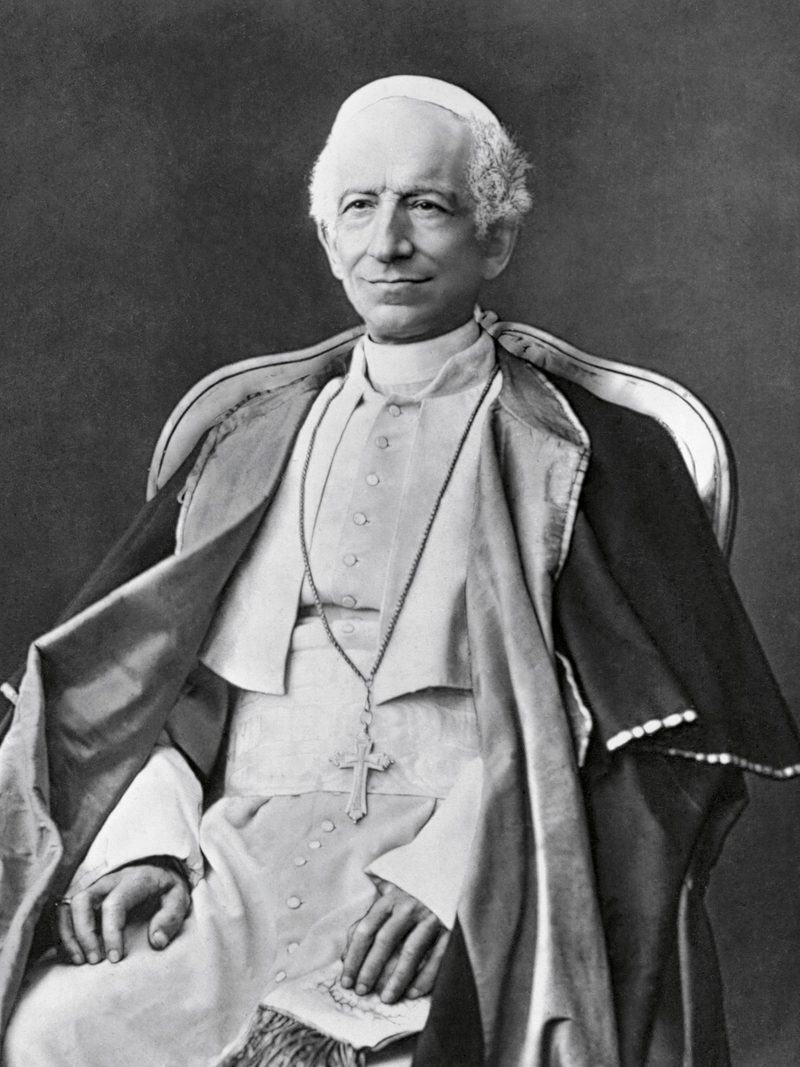

Rome, 1891
The new industrial world has left many workers poor and unprotected, and socialism promises to fix it by abolishing private property.1
An eighty-one-year-old pope publishes a letter called Rerum Novarum, on the relations between capital and labour.1
It is still the foundation of everything the Church teaches about work and justice.
01Leo XIII
Of new things
Leo XIII defended the rights of workers, including a just wage and the right to form associations, while rejecting socialism.1
The Church’s social teaching insists that the economy exists for the human person, not the other way round.2
He was an old man when he wrote it. The questions he raised have only grown younger.
02Leo XIII
Faith and reason
Leo encouraged the study of St Thomas Aquinas and opened the Vatican Archives to scholars.1
The next pope was a village boy who never forgot children.
Notes
- Catholic Encyclopedia (1913), “Pope Leo XIII”. New Advent edition. newadvent.org
- Catechism of the Catholic Church, paragraph 2426. vatican.va
- Catholic Encyclopedia, “List of Popes” (New Advent edition, updated to 2025). New Advent edition. newadvent.org
The Catholic Encyclopedia (1913) is in the public domain; we quote the New Advent edition. Texts of the Holy See are quoted briefly from vatican.va. Scripture: Douay-Rheims, Challoner revision (public domain). Photographs: Wikimedia Commons, credited under each image; full list on the photo credits page.
Lines in the narrator’s voice, without a note, are our reflection, not a historical claim. Stone & Incense restates Church teaching in plain words; our wording is not an official Church text. Report an error.