
Home / The popes / St Callistus I
The port of Rome, around AD 190
A slave named Callistus sees his master’s boat coming across the harbour and jumps into the sea.1
He is pulled out, dragged ashore, and sent to the punishment kept for slaves: turning a hand-mill.1
Thirty years later, that slave was the bishop of Rome.
01St Callistus I
The worst possible CV
Callistus had been the slave of a Christian named Carpophorus, who trusted him with money for a bank; the money was lost.1
Most of what we know about him comes from his bitter enemies, Tertullian and the antipope Hippolytus, so the story is told against him.1
Read that twice. Our main source for this pope is a man who wanted his job.
02St Callistus I
Keeper of the dead
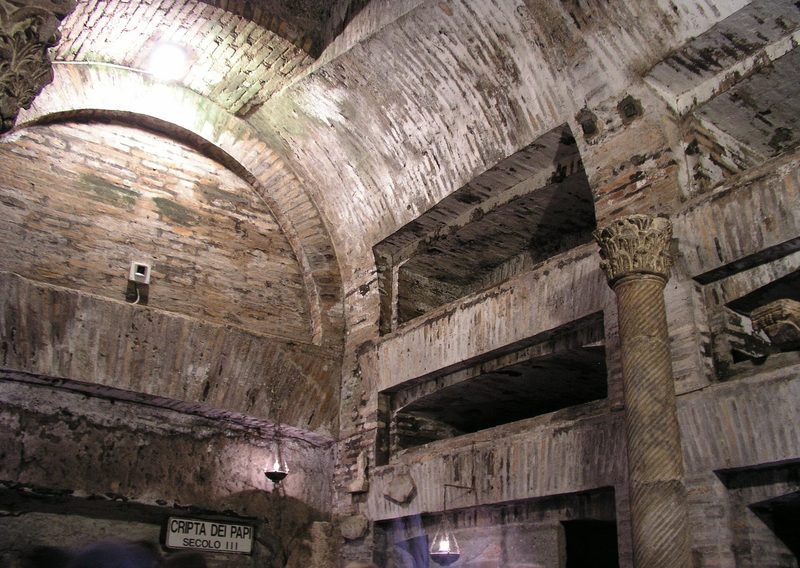
When Zephyrinus became pope, Callistus was recalled and set over the Church’s own cemetery, which has borne his name ever since.1
Hippolytus attacked him for receiving repentant sinners back into communion, and the Church sided with mercy.1
The Church teaches that there is no offence, however serious, that the Church cannot forgive.2
A century on, the persecutions would end, and a pope would walk into an imperial palace.
Notes
- Catholic Encyclopedia (1913), “Pope Callistus I”. New Advent edition. newadvent.org
- Catechism of the Catholic Church, paragraph 982. vatican.va
The Catholic Encyclopedia (1913) is in the public domain; we quote the New Advent edition. Texts of the Holy See are quoted briefly from vatican.va. Scripture: Douay-Rheims, Challoner revision (public domain). Photographs: Wikimedia Commons, credited under each image; full list on the photo credits page.
Lines in the narrator’s voice, without a note, are our reflection, not a historical claim. Stone & Incense restates Church teaching in plain words; our wording is not an official Church text. Report an error.