.jpg)
Lyons, in Roman Gaul, around the year 180
St Irenaeus of Lyons is answering teachers who say the apostles passed on hidden mysteries in secret. His answer is a list of names: the perpetual succession of bishops in the Churches.5
The apostles, he writes, “committed into the hands of Linus the office of the episcopate.” After Linus came Anacletus, and then Clement, a man who “had seen the blessed apostles.”5
He keeps going, name after name, down to his own day. Where does a list like that begin?
01The beginning
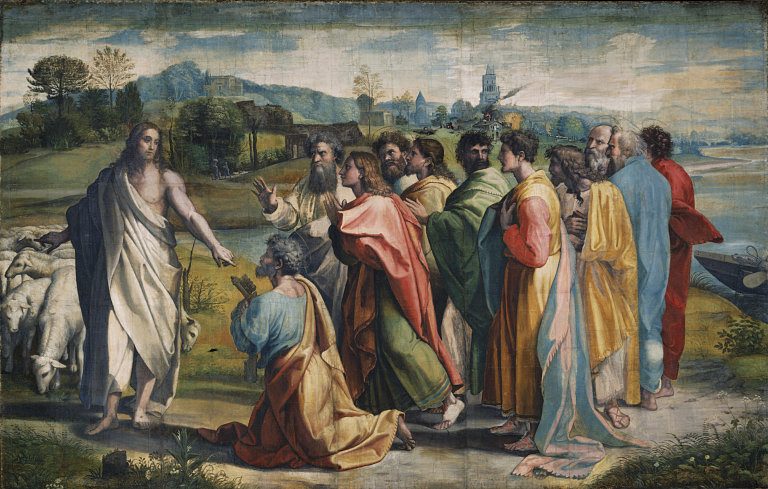
Peter, the rock
“And I say to thee: That thou art Peter; and upon this rock I will build my church, and the gates of hell shall not prevail against it.”
The Catechism teaches that the Lord made Simon alone, whom he named Peter, the rock of his Church, and gave him the keys.7
But did the first Christians think the apostles’ role was meant to pass on? One of them says so in writing.
02Around the year 96
Clement of Rome
Clement wrote that the apostles appointed ministers and gave instructions that when these should fall asleep, “other approved men should succeed them in their ministry.”4
“Our apostles also knew, through our Lord Jesus Christ, that there would be strife on account of the office of the episcopate.”
A few years later, another bishop was writing letters under armed guard.
03Around the year 110
Ignatius of Antioch
On his way to martyrdom, Ignatius wrote: “Wherever the bishop shall appear, there let the multitude [of the people] also be; even as, wherever Jesus Christ is, there is the Catholic Church.”8 The Catechism still quotes his words.9
Which brings us back to Irenaeus, and the end of his list.
04Around the year 180
Irenaeus, and the twelfth name
Irenaeus finishes with the bishop of Rome in his own day: Eleutherius, “in the twelfth place from the apostles.”5
“In this order, and by this succession, the ecclesiastical tradition from the apostles, and the preaching of the truth, have come down to us.”
The Catechism quotes him on the Church of Rome: “For with this church, by reason of its pre-eminence, the whole Church, that is the faithful everywhere, must necessarily be in accord.”10
Twelve names by the year 180. Today the list is much longer.
05Today
The 267th
Pope Leo XIV, elected on 8 May 2025, is the 267th Successor of Saint Peter.11 The Church teaches that the bishops have by divine institution taken the place of the apostles as pastors of the Church.2
Your own parish belongs to a diocese, and your diocese has a bishop. He is part of that same line.
Linus, Anacletus, Clement, and on down. Irenaeus started the list. You can find the newest names yourself.
Careful with the facts
- Early writers differ in small details: Irenaeus places Clement third after the apostles, while Tertullian says the church of Rome records that Clement was ordained by Peter.512
- For many centuries East and West followed their own ways in a brotherly union of faith and sacramental life, and the Roman See by common consent acted as guide when disagreements arose.13
Christian to Christian
Catholics and Orthodox stand close together here: the Catholic Church teaches that the Orthodox Churches possess true sacraments, by apostolic succession, above all the priesthood and the Eucharist. 1415
Watch
Does the Catholic Church Have Unbroken Apostolic Succession?Catholic Answers · Catholic Answers Live · 4 minYouTube
Very First FathersJimmy Akin · Jimmy Akin · 52 minYouTube
From the official channels of the teachers named. Links checked 4 October 2026; an editor has not yet watched every video in full. Scripture and the Catechism cited on this page are the authority. All videos by topic.
Only one thing to do
Your one next step
Look up the name of the bishop of the diocese where you live. A quick search for your town and the word “diocese” will usually find it. That is one living link in the chain Irenaeus wrote down.
Find a parish near youKeep going
Notes
- Catechism of the Catholic Church, paragraph 77. vatican.va
- Catechism of the Catholic Church, paragraph 862. vatican.va
- Catechism of the Catholic Church, paragraph 880. vatican.va
- St. Clement of Rome, Letter to the Corinthians (c. 96). Ante-Nicene Fathers vol. 1 (1885), trans. Roberts and Donaldson. newadvent.org
- St. Irenaeus of Lyons, Against Heresies III.3 (c. 180). Ante-Nicene Fathers vol. 1 (1885). newadvent.org
- Matthew 16:18, Douay-Rheims. read the chapter
- Catechism of the Catholic Church, paragraph 881. vatican.va
- St. Ignatius of Antioch, Letter to the Smyrnaeans 7-8 (c. 107-110). Ante-Nicene Fathers vol. 1 (1885). newadvent.org
- Catechism of the Catholic Church, paragraph 830. vatican.va
- Catechism of the Catholic Church, paragraph 834. vatican.va
- Holy See, Biography of the Holy Father Leo XIV. vatican.va. vatican.va
- Tertullian, The Prescription Against Heretics 32 (c. 200). Ante-Nicene Fathers vol. 3 (1885). newadvent.org
- Unitatis Redintegratio 14 (Vatican II, Decree on Ecumenism, 1964). vatican.va
- Catechism of the Catholic Church, paragraph 1399. vatican.va
- Unitatis Redintegratio 15 (Vatican II, Decree on Ecumenism, 1964). vatican.va
Translations of the Fathers and councils are public-domain 19th-century editions. Catechism links open vatican.va. Scripture: Douay-Rheims, Challoner revision. Stone & Incense restates Church teaching and history in plain words; our wording is not an official Church text. Report an error.